Brand New at the Library!

Wednesday, October 28, 2015


Bridget Jones: Mad About the Boy by Helen Fielding
Review by Gerti

I love Bridget Jones and I'm not afraid to say it.  I'll shout it if you need me to.  I love Bridget Jones, and I love the many books (3 now) that Helen Fielding has penned about her wacky adventures.  I love that Bridget keeps track of the same crazy things I do--calories, weight, etc., but I also love that she keeps track of things I never do--like alcohol consumed or boyfriends shagged.  Having her be similar to me in some ways and different in others means I can laugh with her, and AT her, at different times, but always with the utmost affection.

In her previous diaries, Bridget had two wonderful men after her, including mark Darcy (played by Colin Firth in the movie version) which totally makes me love him, too.  Her former boss Daniel was played by Hugh Grant, and there are not two British men in the world that I adore more than Firth and Grant.  So even as I read about their adventures, in my mind I can see their gloriously handsome faces, and imagine their endearing mannerisms.  Yes, I do have it bad, than you very much.

Bridget Jones to me now is also the actress, Renee Zellweger, so as she gets her white coat stained by her daughter's hot chocolate before a major school even, I see her face, and that makes it all so much more intimate.  It's like watching the adventures of a friend, a clumsy, humorous, accident-prone, self-doubting, weak-willed friend whom I love.So in this book, "Mad about the Boy", I am not totally put off it becausd mark Darcy has died tragically.  Like helping a widow through hter days of grief, I stuck by Bridget as she tied to take care of their two kids, and make a new life for herself among the ashes.  I loved how she tried to engage with the modern world, tweeting, getting on FB (or not), and dealing with all the uber-moms at the children's school.  I liked how she found a young man to date, but saw the plot twist coming when an older man (equally buff, though. Bridget doesn't date ugly men!) from her son's school became her friend.

In short I love Helen Fielding's writing style, and this story, and while there are a lot of things happening to the English language in England that don't really click with Americans like me (who don't spend time overseas), you catch on eventually, even to unusual terms like Spag Bog (Spaghetti Bolognese).  Yes, it's apparently one of England's most popular meals, and Bridget's kids love to eat it.  those touches give the book its unique flair, and while I missed Darcy, I was rooting for Bridget to succeed at putting her life back together, and she has.  By the end, she's got a better relationship with her Mom, her Neighbors, even the most put-together mom at school as she finds out everyone is just bumbling along, despite appearances to the contrary.

I'm told they are working on the movie version of this book, but Hugh Grant refused to be in it, which is a sham.  If the movie is even half as fun as reading the booi, consider my ticket already bought.

Friday, October 23, 2015


To Kill a Mockingbird by Harper Lee
Review by Gerti

I recently told a Hobart librarian that I didn't like this book, but the truth was that I hadn't read it since I was in high school.  So to be fair, and to get a feel for the characters again before reading "Go Set a Watchman"' I picked up the kid's paperback.  I had forgotten what a rich experience this classic book is, and I think it is a better read now than 30 years ago for me, since I now know so much more about the author and the other characters, as well as about life!

Who doesn't love the main characters of Scout, Jem, Atticus and Boo Radley?  Having done some reading about Truman Capote, I found out that the character of Dill was about him, since he and Harper Lee grew up as neighbors.  This means that if we assume Scout is Harper herself, than what she says about Dill gives me an insight into the boy Capote was before he became a famous writer, and that to me is fascinating.  You see through her text how the dysfunction and disorder in his family life made him a broken toy, and a brilliant author.

I also looked beyond the traditionally taught message of how poorly black people were treated in 1930's Alabama, to see how women were treated at the time, and was amazed to find the huge number of references Lee makes to what a Southern woman is and should not be, and what constitutes lady-like behavior to the older generation of women in her town.  Lee's book was modern not only by showing how unfairly black people were treated by the population at large and by the justice system in particular, but also showed how sexual stereotypes hurt Scout and Dill as they grew up unable to conform to the social standards of the past.

The plot is pretty well known: the children of a widowed Southern lawyer suffer hostility from local children and adults while their father defends a black man wrongly accused of raping a white woman.  While Atticus Finch proves beyond a doubt that Tom Robinson never committed the crime, the jury still convicts him, and he dies trying to escape.  But during the trial, Atticus shows that Bob Ewell, the father of the accuser, is a liar, an drunkard and a child abuser, and that rankles the man so much that he tries to hurt the Fnch kids while they are coming home from a school play one dark evening.  Only the intervention of a local recluse, Arthur "Boo" Radley, prevents the children's injuries from being worse.  

So yes, Mr. Librarian, I have now re-read the book and find that I love it.  I can't wait to read Lee's sequel, despite all the negative press it has gotten.  her writing here is lovely, as she uses Scout's childish, southern-accented voice to tell her larger tale of a certain time period in American history.  But that doesn't prevent the other characters in the book from coming to life, as they do.  This book makes me sad that Lee didn't publish more novels, but I'm hoping we'll find more manuscripts of hers eventually.  TKAM is a classic novel that everyone should read once (or maybe twice!) in their lives.

Monday, October 19, 2015


Woman in Gold

Movie Review of Woman in Gold
Review by Gerti

Gustav Klimt is an artist from turn-of-the-century Vienna whose work you either love or hate.  I happen to love it, and saw many canvases in person in a gallery in Vienna when I visited many years ago.  One of Klimt's most famous works is often called "Woman in Gold", just like the name of this movie, but it is actually the portrait of Adele Bloc-Bauer, and this movie is the story of Adele's niece, Maria Altmann, and her fight with Austria to get that popular picture back.

Actress Helen Mirren plays Altmann, an emigre from Austria in the 1930's now residing in America.  She and several lucky members of her family fled when the Nazi's took over Austria and made things difficult for Jewish people.  They left with just the clothes on their backs, and the Nazi's took away their businesses and possessions, which for Maria's family included 5 gorgeous Klimt pictures.

Several decades after WWII, the new Austrian government wanted to make things right for the families who had been robbed by the prewar policies.  Maria spotted an article about it in the New York Times which made her wonder is she could get their families pictures back as well.  Her friend's son is a young and inexperienced lawyer named Randy Schoenberg, played handsomely by Ryan Reynolds.  His family also emigrated from Austria, and they are related to famous composer Arthur Schoenberg, which shows that they are also cultured people.  Randy is captivated by Maria's hard-luck story and plucky personality, and decides to make the trip to Europe to see if he can help reclaim her treasures.

As a young Austrian reporter says, though, the "Woman in Gold" is Austria's Mona Lisa, and that country is very reluctant to return it, despite their desire for good publicity, and justice.  They claim Adele's will says it goes to the Belvedere Gallery, but Randy and Maria prove that since Adele's husband bought the pictures, and he outlived her, it's his will that dictates what happens to them, and he gave the to Maria.  Austria continues to fight, this time using money as a weapon, andRandy has to take the legal case to the US Supreme Court (and win) before Austria finally agree to mediate.  Throughout the movie, Maria wants to come to an agreement with the Austrian museum, but they make it very hard on her, as do her many memories of ther final frantic days in that nation in 1938.

This move will move you to tears, and make you laugh.  It is a fascinating story of how Austria finally makes things right for he elderly American lady.  The acting is top notch, the story is well written and the music beautiful, including some phrases I recognized from a movie adaptation of Jane Austen's "Persuasion."  The film is also visually appealing, with Austria's beautiful urban scenery contrasting sharply with the incomprehensible horrors of its past.  There is a happy ending, with Austria doing the right thing, and it is nice to see Maria vindicated, and Randy getting his career started with such a rousing success.  With no graphic images to frighten younger viewers, I heartily recommend this stunning "Woman in Gold".


Monday, October 12, 2015

Image result for take a bow by elizabeth eulberg


Take a Bow by Elizabeth Eulberg
Reviewed by Gerti

This is the second young adult novel I've read by Elizabeth Eulberg.  Her "Prom and Prejudice" was a clever send-up of Jane Austen's classic novel of British literature, "Pride and Prejudice".  I loved that book, but found "Take a Bow" to be a bit lackluster, perhaps because I wasn't as interested int he subject matter.

The main character of this book is Emme Connelly, a red-headed, green-eyed beauty who does not like to be the center of attention.  This contrasts with her best friend at the beginning, Sophie Jenkins, a star in the making, and the reason both girls attend a performing arts-oriented high school called CPA in New York City.  Sophie seeks the spotlight as a singer, and the although Emme also loves music, she writes it instead, which make them a perfect partnership.  Only Sophie isn't happy that Emme's star is rising at CPA, as Emme has become involved with three other guys and formed a band, Teenage Kicks, which despite the sad name is receiving mild success even outside school now that they are seniors.

in an attempt to get her name in the public eye, Sophie starts to date a former child star who in on the acting track at the school, a boy named Carter Harrison.  She appears with him at all kinds of events, but is mad that the pictures are usually cropped to cut her out.  She also has a musical rival at the school, so even when there are musical productions there, Sophe doesn't get the lead.  her trump card is the original music that Emme writes for her, bus she abused the friendship.  Sophie gets a new best friend, give her the credit for a great song Emme wrote her, and those girls trade catty e-mails about Emme that she accidentally sees.  Nice girl Emme finally decides it's time to ditch this user loser.

Sophie tries to explain things away as she has done many times before to get back in Emme's good graces, but it's no good.  Emme's star rises as she is a featured performer at CPA and gets accepted at Julliard.  Sophie's nasty tricks finally do her in, as Emme refuses to help her anymore.  Sprinkle this friend drama with a few cute boys, and you've pretty much got what this book is about.

While I do like Emme as a character, as well as the other three guys in the band (including Ethan, who love love loves Emme), Sophie is just too nasty to enjoy reading about.  Eulberg breaks the book up into alternating chapters told from delusional Sophie is about Emme, blaming the latter for all her troubles (even though Emme has been nothing but supportive until the end), it is also distracting for the book to be splintered like that.  i also disliked how Eulberg narrated many conversations in the book, a page-filling technique I think she took from David Levithan, who I've seen use it before.  I don't like his books at all, and feel that the's been a negative influence on Eulberg as a writer,  I have yet to read " The Lonely Hearts Club", written by her, but have my fingers crossed that it will again be as good as "Prom and Prejudice".

Wednesday, October 7, 2015


Product Details


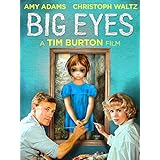
Movie Review of Big Eyes by Tim Burton
Reviewed by Gerti 

"Big Eyes" is a Tim Burton film about one of the most famous American woman artists of the 20th century, Margaret Keane.  Her paintings of waifs with the eponymous "big eyes" were everywhere in mid-century America.  I clearly remember them hanging in the office of my family doctor, where they scared the heck out of me!  The effect was made worse by the fact that one of his exam rooms had a waif in a harlequin outfit, and the creep factor was completely off the charts.  So I could hardly wait to see this movie about the paintings and the artist who created them.

Actress Amy Adams stars as that artist, Margaret Keane, who had a bumpy road to fame and fortune, since her husband Walter spent almost a decade pretending to be the person behind the paintbrush.  In the movie, the deceit begins innocently enough, with a bit of confusion between his cityscapes and his wife's waifs occurring during a conversation with a customer.  But this confusion turns into a persistent lie that Walter Keane tells, and since he is more con-man than artist, more salesman than spouse, he tries to convince Margaret that this is how it has to be.  Nobody he says wants woman art.

Walter Keane is played with evil genius by Christoph Waltz.  Keane starts off a charming man, and is able to sweep Margaret off her feet in San Francisco, mere weeks after she had fled there with her daughter from her first unhappy marriage.  They marry quickly so Margaret doesn't lose her daughter to her first husband, who claims she she is unfit to raise the girl as a single mother.  Remember, this was the 1950's.  Mr. Keane goes off the rails after te money and the famous patrons begin to come their way, and while I'm not sure how accurately the movie portrays the lives of the people involved, but it seems he succumbs to alcoholism, which makes him resort to physical violence to control Margaret.

She once again flees with her daughter, this time to Hawaii.  Walter tracks her down, blackmailing her into painting more "big eyes"pictures for him before he'll sign the divorce.  But by now, Margaret is sick of being intimidated, and files a lawsuit against him, telling the world the truth behind the fraud.  Walter fights her, even acting as his own attorney at one point, but like the wise biblical King Solomon, the judge sees the only true test is to have each of the people in the lawsuit paint a picture.  Margaret whips off a "big eyes" picture in less than an hour, and Walter defers, saying he is suffering from an injury which leaves him unable to paint at the moment.  It is a beautiful moment of victory for Margaret!

This is a movie that will not move you to tears, or make you laugh.  It is, however, an interesting story of a couple involved in a stormy relationship which just coincidentally involves some of the first vastly commercial popular art in America.  The acting is top notch, the story well written, and the film visually appealing.  And just on a human level, it is nice to see Margaret finally vindicated.

Wednesday, September 30, 2015

 Sense and Sensibility by Joanna Trollope

Review by Gerti

Let me start by saying that it takes enormous cheek for a writer of any reputation and ability to name her book after one which is already considered a classic. I think Jane Austen’s “Sense and Sensibility” qualifies as such, and Austen is a popular enough author that many people know of the novel, even if they haven’t read it. So for Joanna Trollope (who?) to name her novel the same thing, and to use many of the same characters, is an outrage to me.

I’m sure Trollope, a popular author of many other books and an Austen fan, would say that she has just modernized Austen’s story, and therefore has the right to use the characters and just loosen things up a bit, morally speaking, and throw in some modern tech, like computers and Facebook. Since I’ve read many other Austen-homage books, I should be comfortable with that sort of thing, done successfully in “The Jane Austen Book Club” and “Austenland”, among other texts. But none of those authors were bold enough to just call their books “Pride and Prejudice” or any of Austen’s other well-known titles, and I don’t think Trollope should have taken that liberty, either. Her work pales by comparison.

As for the story Trollope writes, it follows the direction of Austen’s work, even if Trollope has added embellishments, like giving first names to characters like Mrs. Dashwood, the mother of Elinor, Marianne and Margaret, and to Colonel Brandon. While Brandon retains most of his dignified character from the original, “Belle” Dashwood comes off as an unlikeable, selfish hippy. Her imprudence (at not marrying Mr. Dashwood in the first place) sets up the fall from grace for the family of four women, as they are sent from their house at Norland when Henry Dashwood’s son (by his real wife) inherits the estate. Elinor is still the sensible daughter, and she recognizes the need to get work when they are sent packing, but neither Belle nor Marianne, the younger daughter, are grounded enough in reality to feel the need to contribute financially to the family’s survival. Marianne is young, which makes her sin of selfishness more forgivable, but it is intolerable to have middle-aged Belle simply live off the charity of a relative (Sir John Middleton) or her daughter’s paycheck. Belle also tries to mooch off of Mrs. Jennings when country living gets too boring for her, but fortunately the old lady is wise to her manipulative ways and does not ask her to join her in London.


But is the story worth reading? Yes, I suppose it is, for desperate Austen fans, but mainly for the ending, where Trollope goes beyond Austen’s story and has Edward’s mother forgive him for his youthful indiscretion with Lucy Steele, and give him a little money. The end also finds Fanny Dashwood getting a comeuppance by her mother, whom she is trying to manipulate so she’ll cut her brother Robert out of her will, as she did with her brother Edward. The mother doesn’t fall for it, which makes this reader for one cheer to see Fanny thwarted in at least one of her greedy escapades. As for “Trollope’s voice” which is vaunted by a cover blurb praising the author, I find it sadly unequal to Austen’s original.

Monday, September 28, 2015

I am Legend and Other Stories by Richard Matheson

Reviewed by Gerti

If you’re like me, you've heard of the movie with Will Smith called “I Am Legend”, but you've never heard of author Richard Matheson. That’s why his collection of short fiction is a delightful discovery. Not only do you find the short novel that was the impetus for the Hollywood blockbuster (although the plots are very different), you will also find another horror classic – the story of the Zuni fetish doll made famous by Karen Black in “Trilogy of Terror”. Yes, that’s Matheson’s story, too.

Spanning from 1951 to 1987, this collection of one short novel and 10 short stories penned by Matheson is a fascinating look at the author’s twisted takes on what it means to be human. Just about every story contains death, often with the main character killing others, but there is also a hint of the paranormal. One story features 7 beautiful teen-aged witches who kill men in horrible but unique ways; another has a witch doctor’s curse which threatens the life of a successful New York City man. Each story contains an extraordinary conflict – my favorite being between an author and his “Mad House”, a home which he has filled with so much anger and frustration that the inanimate objects in it conspire to kill him.

I am bothered that the headlining story “I Am Legend” is actually more like the 1964 Vincent Price film “The Last Man on Earth” and the even campier 1971 movie “The Omega Man” than Will Smith’s movie. Robert Neville in Matheson’s novel is not plagued by fast zombies so much as by a form of infected but evolving humans, and they are angry that he has been killing them, so they send in a “healthy” decoy to kill him. Even though Neville is suspicious of her, he has been alone (and lonely for female company) for so long, that he wants to believe she is human, like him. While she can’t kill him, she instead warns him that the others will come for him, because they are setting up a new society and his very existence threatens their world. I far prefer the unknown Hollywood script writer’s version with Smith where Neville is not a sex-crazed creep, but a charming hero who eventually comes up with an antidote to cure those infected by this disease.

There are psychological depths to the Zuni fetish doll story, “Prey”, which features a female protagonist - Amelia. She has purchased a birthday gift for her boyfriend, Arthur, but her controlling mother wants to spend that Friday evening with her instead. The doll, called “This is He Who Kills” when she takes him out of his wooden coffin, represents her pent-up rage at being treated like a child by her mom, and the gold chains around him are her frustrated struggle for independence. When she is finally possessed by the doll’s warrior spirit before the old lady comes to visit, we are almost pleased that Amelia has found some form of internal strength and a way to fight back.


In all, these short works make worthwhile reading for science fiction fans. While some are sexist and old-fashioned, Matheson has an engaging writing style, and his tales themselves are all uniquely twisted versions of a very strange world.