Brand New at the Library!

Showing posts with label Movie Reviews. Show all posts

Thursday, March 30, 2017

Washington Square.

Movie Review: Washington Square

Reviewed by Gerti

I have never been a fan of Henry James as a writer. I do however love this movie adaptation of “Washington Square,” one of his books about the upper classes and their “problems”, which in this case is a young woman’s struggle for love.

Here talented actress Jennnifer Jason Leigh plays the protagonist, Catherine, a lonely young woman despised by her domineering father. Albert Finney is the hateful old man who chooses a flighty, flirty aunt to raise his daughter. The girl turns out so socially backward and her awkward  tics and mannerisms seem nearly autistic, and it looks like no one will ever want to marry her. But when a handsome young suitor appears, the father believes his money is the motive for the affection shown to the girl. Dashing Ben Chaplin plays the rogue, who for all his devious motives, turns Catherine’s life around. They kiss, they flirt, they play music together and actually spend time outside the captivity of her house. Catherine naturally falls deeply in love, but when her father maliciously refuses to allow Morris Townsend (Chaplin’s character) to marry her, Morris roughly throws her aside, ostensibly to make his fortune elsewhere.

The scenes where Morris tells Catherine of his mercenary motives and then leaves her, lying in the mud wallowing in despair, are truly pitiful. But Catherine is still not free from Morris, or her father’s hatred of him. When the old miser dies, he leaves her his house, but not his money, saying that if she ever married Morris, even that small inheritance would be taken from her. Catherine, however, finds a new calling, and runs a lovely school from her house, now filled with children whom she loves and who love her back for her innocence and gentleness. When Morris finally returns, she utterly rebuffs him, having at last come into her own power.

There are hard scenes to watch in the movie, like when the sexually repressed aunt flirts with Morris while at the same time encouraging his suit for Catherine. But Catherine can do nothing about the nest of vipers in which she has grown up, and must try to overcome their evil intentions (and selfish motives) the best she can. The only wonder is that she does survive and thrive, despite them. The film is always entertaining, and the message is powerful, showing how Catherine grows from ugly duckling into lovely swan, even though her wings are clipped by her terrible sire so she can never fly away from him. What is her crime? Her beautiful mother died giving birth to another baby (not her), but the grief-crazed father blames Catherine since she survived, and the little boy (and his mother) did not.


The movie will move you to tears many times as you watch Catherine’s struggles for love, and watch her realization that she can’t find it from the people she loves most, including her father and Morris. The movie is filled with fine performances by all the actors. The costumes and sets are also amazingly beautiful, and I recommend it highly.

Monday, March 20, 2017


Breaking away

Movie review: Breaking Away


Reviewed by Gerti

I’ll start by explaining that I checked this movie out of the library because I wanted my daughter to see how lovely the IU Bloomington campus is. I found myself transported back to the late ‘70s, with all the terrible clothing choices and poufy hair, and yet… It was wonderfully nostalgic. Hobart doesn’t have a town/gown tension, but I could easily imagine it in such towns as Valparaiso and South Bend. Film writer Steve Tesich captured that drama perfectly, and Patrick Williams music was memorable. Peter Yates directed the 1979 film.

But what I found most charming was the story of the 4 friends, so-called “cutters”, who are trying to figure out what to do with their lives. Several of the young actors are now famous, including Dennis Quaid and Daniel Stern. The hero of the story, Dave, is virtually unknown (to me) actor Dennis Christopher, who is a delight as a youth obsessed with cycling, and therefore with anything Italian. He worships the Cinzano bicycle racing team, and that manifests itself in a tendency to use Italian when speaking (much to the frustration of his father, who wonders why his son is talking like an “I-tie”) and a newfound love of opera and Italian food. Dave’s mother catches the bug, and uses it to inject a little romance back into her life with her former stone-cutter, now used car salesman husband.

Dave pretends to be an Italian foreign student when he catches the attention of a lovely co-ed at IU, but of course that is doomed to fail. In the final scenes, we see him start speaking French, as another gorgeous foreign student asks his help. But the main drama of the story lies during the Little 500, a bicycle race held in Bloomington which Dave and his friends enter in order to show up the IU cycling team. Dave has a lot of setbacks – the actual Italian team causes him to fall off his bike during another race, so he must rebuild a new, rattier bike his friends have gotten him. He also wrecks during the Little 500, but (the point of the story) his friends rally and even though they’re not great riders, they keep going so that when he’s patched up from his injury, he can get back in and win.


If you can get over the bad quality of the film, the bad hair and the repulsive fashions, “Breaking Away” will charm you. It will remind you of your days trying to “break away” from your parent’s house, and their expectations of you. Some of the parents expect their kids to fail, others to succeed. But the boys here eventually get to the psychological point where it doesn’t matter what their parents think of them – they are going to do what they love. For Dave, it’s finally go to college on the IU campus, where his father once cut the limestone for the impressive buildings. This movie shows how each of us gets past the previous generation, and learns to travel our own paths. A sports film that gets beyond successful cycling and keeps going on sheer heart, just like the boys in the Little 500. Will make you want to head down to Bloomington for the race…    

Friday, March 17, 2017


Hoosiers

Movie Review: Hoosiers 

Reviewed by Gerti

The inspirational 1986 movie “Hoosiers” is a classic, and not just to the people of Indiana. It’s a film that shows the love of simple people for the game of basketball, the premise being that we Indiana-living folks just eat, sleep and breath basketball, and that any road you drive down in the Hoosier state, you’ll see some boy shooting hoops. I don’t know how true that is anymore, certainly not in this part of Indiana, but the movie does live up to the moniker ESPN gave it, as one of the best sports movies of all time. Several performances, including those by Gene Hackman and Dennis Hopper, as well as the film score by Jerry Goldsmith, are award worthy, even if they didn’t win Oscars.

The plot is based loosely on the 1954 state championship game between little Milan High School and big-time, high-enrollment Muncie. For some reason, the filmmakers (director David Anspaugh and writer Angelo Pizzo) felt they needed to change the original storyline, and suddenly, the town is named Hickory, and they play South Bend in the finals, not Muncie. The coach’s name is changed too. Hackman plays Norman Dale, who has come to this little Indiana town as his last shot at redemption thanks to the principal at Hickory, an old friend. Apparently, Dale got into trouble before for hitting one of his star college players. The town’s longtime coach has retired, and everybody has an opinion about how the current team of 7 boys should be coached. Dale alienates all the adults, and a few players, too, until the boys apologize and come back (in one of the deleted scenes. Crazy, I know.) But Coach Dale is so good, he takes these boys with a love of the game and turns them into champions by forcing them to do conditioning and learn the basics. They win sectionals, regionals, etc. and then win by a squeak in the championship. Cinderella story = good drama.

Drama is also infused when the townfolks try to fire Coach Dale, but the star player says he won’t play without him. Barbara Hershey appears as a supposed love interest of Coach Dale, but I truly wish they had left that part out. First she hates him, then she loves him. Yawn. It’s been done before. A better story line is that of Dennis Hopper, Shooter, who knows the ins and outs of the game, as well as the strengths and weaknesses of other teams, when he’s sober. He’s been fighting against the bottle (and losing) for years, but Coach Dale gives him a chance to redeem himself, and (hoorah) he kind of does.


This Collector’s Edition has a copy of the real game that took place between Milan and Muncie on the DVD, which is cool. If I really cared about basketball, I’d have watched that, since the final few minutes are supposed to match precisely. The producers were really careful about that. Now why they took the original story and changed all the names, that I don’t understand. You want to be accurate, but then you want it to be fictional. Hoosiers is “the best basketball movie of all time”; I only wish the filmmakers had thrown out the romance and given the “long-shot triumphs” storyline an authentic treatment.  

Tuesday, March 14, 2017

The man from U.N.C.L.E.

Movie review: The Man from U.N.C.L.E

Reviewed by Gerti


I’ll start by explaining that I’ve seen a number of James Bond movies, but most of those were in college, which was more than a few years ago. I haven’t enjoyed any movies from that shop-worn franchise since the late ‘80s, so it comes as a complete surprise to me how much I enjoyed watching “The Man From UNCLE.” I thought it sounded like the same sort of sexist drivel that constitutes the non-car-chasey parts of the Bond films, yet I found UNCLE much funnier, much more appealing, and can’t wait for the sequel to this movie, if there is one. Yes, please!

This movie reminds me of Bond films, as there are exotic locations, scads of leather-clad thugs who want to do harm to the movies principal actors, and of course, some major enemy baddie of the US to hate. But what makes this Guy Ritchie directed movie different is – the tone. The male principals are Napoleon Solo (played ever so handsomely by Henry Cavill) and Illya Kuryakin (played effectively enough by Armie Hammer). I know there are some ladies who would argue with me, but I think where the Bond movies fall down is that, with the exception of Pierce Brosnan, none of the actual 007’s have been attractive. I won’t use the term coined by some of the feminists in the ‘70s to describe such a man, but let’s just call him dateable. The Bond films are implausible to me, because I could never see swooning over (or getting to second base with) any of the guys who played Bond. This movie, however, is a horse of a different color.

Guy Ritchie seems to understand that what will bring in a female audience hungry for adventure is sexy male actors, and this movie has them in spades. I find Cavill to be Grecian in his perfection, and even one of the villians was yummy-enough to watch. Female protagonist Alicia Vikander was also a positive – cute, but not so gorgeous that any viewer would feel intimidated. I loved the large amount of German spoken in the movie, since Vikander is originally working in East Germany as a mechanic. Yes, the movie is set in the cold war, so it’s Capitalism versus Communism, Solo vs. Kuryakin. But to me, it’s brunette versus blonde, as both male leads are attractive in their own way. Wowza!

And the dialogue! This film feels so modern, with the sex-appeal set to sizzle, but without all the overt sleaziness that makes Bond films so distasteful to women. It’s the men who are the sex objects in this flick, and that’s just fine by me! I won’t even bother summarizing the plot, because it’s secondary (or even tertiary) to what really matters in this movie – hot men running around the world being clever. There is even a scene where they argue about fashion! Be still my heart! And for the older ladies, Hugh Grant plays a British agent. Color me satisfied!


Does it all make sense? I don’t really care. Cavill in a finely tailored suit is all I need for hours of enjoyment, and whatever atomic device is being built or stolen, I could give a flying donut’s worth. This movie is eye candy raised to the nth degree, and I thank the director for recognizing women buy movie tickets, too.

Friday, November 11, 2016


The wall

Movie review, The Wall by Julian Poelsler
Reviewed by Gerti

When you think of "The Wall," most likely you think of the album and movie by the British rock band, Pink Floyd.  That's probably why so few people, myself included, have heard of this brilliant post-apocalyptic film of the same name, main in 2013 by Austrian director, Julian Poesler.  It is based on a book by Marlen Haushofer, and stars the unknown-to-me actress Martina Gedeck, who is onscreen almost the whole time.

It tells the story of a woman, played by Gedeck, who accompanies an elderly couple to their hunting cabin in the upper Austrian alps.  The pair decide upon arriving to walk down to the nearest village, but when they fail to arrive that evening, their companion simply thinks they were too tired to return by foot the same day.  By the next morning, however, she fears the worst for them, and rushed down the path they took that afternoon to try and find them, in case one has suffered a heart attack or some other injury.  She takes with her the couple's dog, Lynx, who the day before had curiously refused to accompany them.

What she finds is that an invisible wall, clear as a window, cuts her off from the rest of humanity.  She feels along its length like a mime, and eventually tries driving the couple's Mercedes into it.  The car crashes; the wall is that strong.  She spends much of the early film trying to test its limits in size and strength, seeing if she can go down the other side of the mountain to get past it, but she cannot.  She and Lynx are trapped, but trapped in such a paradise, that it seems as though loneliness is her only enemy.

Over time, she and Lynx meet a pregnant cow, who has a calf and keep them supplied with milk.  Their party of survivors grows larger when a stray cat turns up in a terrible rainstorm.  That cat also has a kitten, but things turn out badly for both young animals.  As the months and years go by, you see the woman's life through her diary written on the reverse sides of calendars she finds at the cabin.  She narrates her story for the viewer, an impressive one of hope and despair, fear, and ultimately survival.

The story and the movie are uniquely Austrian.  Breathtaking Alpine scenes are shown to the most beautiful violin music, in contrast to the harsh, insipid rock 'n'roll the older couple played on their way to the cabin.  The woman has deep and poignant thought about the meaning of life, the relationship of man to nature, and her relationship to her animal companions.  In this apocalypse, she learns to plant and harvest food, caring for her small group and interacting with the other animals of the forest.  She regards herself as a "one off", sole survivor in a world without other humans, until one day something terrible happens.  

The movie is a love letter to the Alps, and a deep conversation about what it means to be human, for good or evil.  It is haunting and spectacular all at once.

Monday, October 19, 2015


Woman in Gold

Movie Review of Woman in Gold
Review by Gerti

Gustav Klimt is an artist from turn-of-the-century Vienna whose work you either love or hate.  I happen to love it, and saw many canvases in person in a gallery in Vienna when I visited many years ago.  One of Klimt's most famous works is often called "Woman in Gold", just like the name of this movie, but it is actually the portrait of Adele Bloc-Bauer, and this movie is the story of Adele's niece, Maria Altmann, and her fight with Austria to get that popular picture back.

Actress Helen Mirren plays Altmann, an emigre from Austria in the 1930's now residing in America.  She and several lucky members of her family fled when the Nazi's took over Austria and made things difficult for Jewish people.  They left with just the clothes on their backs, and the Nazi's took away their businesses and possessions, which for Maria's family included 5 gorgeous Klimt pictures.

Several decades after WWII, the new Austrian government wanted to make things right for the families who had been robbed by the prewar policies.  Maria spotted an article about it in the New York Times which made her wonder is she could get their families pictures back as well.  Her friend's son is a young and inexperienced lawyer named Randy Schoenberg, played handsomely by Ryan Reynolds.  His family also emigrated from Austria, and they are related to famous composer Arthur Schoenberg, which shows that they are also cultured people.  Randy is captivated by Maria's hard-luck story and plucky personality, and decides to make the trip to Europe to see if he can help reclaim her treasures.

As a young Austrian reporter says, though, the "Woman in Gold" is Austria's Mona Lisa, and that country is very reluctant to return it, despite their desire for good publicity, and justice.  They claim Adele's will says it goes to the Belvedere Gallery, but Randy and Maria prove that since Adele's husband bought the pictures, and he outlived her, it's his will that dictates what happens to them, and he gave the to Maria.  Austria continues to fight, this time using money as a weapon, andRandy has to take the legal case to the US Supreme Court (and win) before Austria finally agree to mediate.  Throughout the movie, Maria wants to come to an agreement with the Austrian museum, but they make it very hard on her, as do her many memories of ther final frantic days in that nation in 1938.

This move will move you to tears, and make you laugh.  It is a fascinating story of how Austria finally makes things right for he elderly American lady.  The acting is top notch, the story is well written and the music beautiful, including some phrases I recognized from a movie adaptation of Jane Austen's "Persuasion."  The film is also visually appealing, with Austria's beautiful urban scenery contrasting sharply with the incomprehensible horrors of its past.  There is a happy ending, with Austria doing the right thing, and it is nice to see Maria vindicated, and Randy getting his career started with such a rousing success.  With no graphic images to frighten younger viewers, I heartily recommend this stunning "Woman in Gold".


Wednesday, October 7, 2015


Product Details


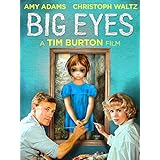
Movie Review of Big Eyes by Tim Burton
Reviewed by Gerti 

"Big Eyes" is a Tim Burton film about one of the most famous American woman artists of the 20th century, Margaret Keane.  Her paintings of waifs with the eponymous "big eyes" were everywhere in mid-century America.  I clearly remember them hanging in the office of my family doctor, where they scared the heck out of me!  The effect was made worse by the fact that one of his exam rooms had a waif in a harlequin outfit, and the creep factor was completely off the charts.  So I could hardly wait to see this movie about the paintings and the artist who created them.

Actress Amy Adams stars as that artist, Margaret Keane, who had a bumpy road to fame and fortune, since her husband Walter spent almost a decade pretending to be the person behind the paintbrush.  In the movie, the deceit begins innocently enough, with a bit of confusion between his cityscapes and his wife's waifs occurring during a conversation with a customer.  But this confusion turns into a persistent lie that Walter Keane tells, and since he is more con-man than artist, more salesman than spouse, he tries to convince Margaret that this is how it has to be.  Nobody he says wants woman art.

Walter Keane is played with evil genius by Christoph Waltz.  Keane starts off a charming man, and is able to sweep Margaret off her feet in San Francisco, mere weeks after she had fled there with her daughter from her first unhappy marriage.  They marry quickly so Margaret doesn't lose her daughter to her first husband, who claims she she is unfit to raise the girl as a single mother.  Remember, this was the 1950's.  Mr. Keane goes off the rails after te money and the famous patrons begin to come their way, and while I'm not sure how accurately the movie portrays the lives of the people involved, but it seems he succumbs to alcoholism, which makes him resort to physical violence to control Margaret.

She once again flees with her daughter, this time to Hawaii.  Walter tracks her down, blackmailing her into painting more "big eyes"pictures for him before he'll sign the divorce.  But by now, Margaret is sick of being intimidated, and files a lawsuit against him, telling the world the truth behind the fraud.  Walter fights her, even acting as his own attorney at one point, but like the wise biblical King Solomon, the judge sees the only true test is to have each of the people in the lawsuit paint a picture.  Margaret whips off a "big eyes" picture in less than an hour, and Walter defers, saying he is suffering from an injury which leaves him unable to paint at the moment.  It is a beautiful moment of victory for Margaret!

This is a movie that will not move you to tears, or make you laugh.  It is, however, an interesting story of a couple involved in a stormy relationship which just coincidentally involves some of the first vastly commercial popular art in America.  The acting is top notch, the story well written, and the film visually appealing.  And just on a human level, it is nice to see Margaret finally vindicated.

Monday, September 21, 2015

Product DetailsMovie Review: The English Surgeon: One Doctor’s Personal Mission to Save Lives in Ukraine 

Review by Gerti
This movie is a real rarity – an exciting documentary. “The English Surgeon” tells the story of neurosurgeon Henry Marsh, who recently penned a book ironically titled “Do No Harm”, which tells the story of his long career performing brain surgery in England and elsewhere. I call the title ironic, because much of the book in fact involves the harm he does patients, whether they live or die.
Those who have read the book will find the movie more interesting, as it shows us the doddering old man behind the stories. Marsh is a middle-aged fellow who likes to work with wood and take used medical equipment to his friend in the Ukraine. The drama only begins in the Ukraine, where Marsh has gone for 17 years, as we see how desperately that country and its citizens need the British cast-offs. Marsh takes part in clinic days in Kiev, where people line the hallways in order to sit for a few minutes before Marsh with their x-rays on a light box.

It is very affecting to see him tell patients their fate. Although we mostly follow the case of one young man named Marion who is able to get an operation and is saved, it is the other mini-cases which are heart-breaking. Marsh and his fellow doctor from the Ukraine, whom he calls Igor, debate whether to tell a 23-year-old beauty that she has only 2 years left to live, but first she will go blind. In the end, they send her to get her mother, so she doesn’t receive the terrible news alone.

Another scene of wrenching human tragedy involves a grandmother who brings the x-ray film of her grandchild, but the great English doctor has no hope for her. “What can we do?” she tearfully asks through a translator. Marsh says that they must prepare themselves that the child will die. It is too late. That is the real tragedy here – that many of these patients could have had a better prognosis, but the government-run process to get x-rayed and then see a doctor is so lengthy that their surgical window has closed. This peek at medicine in the former Soviet state is both fascinating and frightening at the same time.


In short, just as Marsh’s book is a terrifying glimpse at the limits of medicine, so is this look by filmmaker Geoffrey Smith at the efforts Marsh has made in the Ukraine. There are glimpses of the humanity of the Ukrainian people, as when Marsh and Igor visit the mother of a little girl who is now dead, but was wrecked by brain surgery. There is video of her before, a sweet and shy child with a large tumor on her face, and after surgery, where she is virtually helpless but yet alive. They visit her village, and her mother, friends and neighbors set out a spread of food and drink for them. It is obvious how deeply all of them are affected by the visit. But the most enduring picture is as Marsh sits alone by the child’s grave, with the gravestone a sculpture of her face. It is then that the viewer can truly see that Marsh regarded at least one patient as a real human being, and feels her loss deeply. This film will make you cry and give thanks that you are in the USA. 

Thursday, September 3, 2015

Movie: Fifty Shades of Grey

Movie Review: “Fifty Shades of Grey”
Reviewed by Gerti

A movie that has gotten a lot attention is “Fifty Shades of Grey,” based on the blockbuster book of a few years back by EL James. It stars Dakota Johnson as the hapless college student Anastasia Steele who was just helping out a sick roommate when she agreed to interview communications industry titan, Christian Grey. He is played by Jamie Dornan, and in true Cinderella fashion, he instantly falls for the guileless Steele, who is also being pursued by several other young men, but doesn’t know that either. Besides being clueless, all she’s lacking here to make her less sexy is coke-bottle thick nerd glasses. She’s a disaster!

Grey tries to charm her by meeting her at the hardware store where she works. Perversely, he picks up some sado-masochistic supplies while she’s helping him shop – rope, duct tape, etc. She doesn’t get the clues. Then he sends her a first edition of “Tess of the D’Urbervilles”, because she told him she was an English major because of the works of Thomas Hardy. He says he would have suspected Jane Austen, which will give Austen lovers a laugh. Then he gets her a new laptop, and eventually a car. Nice boyfriend!

With the story closely following the book, Grey gradually seduces Steele into his “singular” lifestyle, where she would be his submissive and he her dominant. And while she engages in a few introductory episodes with him, she whines frequently about their just being a normal couple, and doing normal dating things, like going out to dinner and the movies. But she also sends him mixed signals, like agreeing to a business meeting alone in his office and going over the “contract” that he wants her to sign to make their relationship official. She goes through the contract pages with him, having him take out things that are objectionable to her, but then teases him about signing it, and leaves without doing so.

Yes, there is a good amount of nudity, mostly hers, as he introduces her to all kinds of sexual behavior (apparently, she’s a virgin in the story). Thanks to Danny Elfman who did the music, it treads the thin line between sexy and silly, as his soundtrack makes it all seem romantic. Dornan plays Grey as conflicted about this relationship, first not wanting to drag Ana into the lifestyle, but then breaking his own rules whenever they are together. If only Ana could project the allure that has caught him in her spell… She generally comes across as cow-eyed and bumbling. We do hear that Grey had an abusive mother, and was then seduced by one of his mother’s friends. Yes, I guess that could all mess him up pretty good where romance is concerned.

Ultimately, however, I thought the movie actually handled the sex more tastefully than the book. I heard that audiences laughed at certain parts, but I’d love to know when, because I found the sex scenes more appealing than some of the dialogue. The film was more Cinderella soap opera than flat-out porn. But the themes here are not for kids or young teens.

Monday, August 31, 2015

Movie Review: The Rewrite

The rewrite 
Movie Review: “The Rewrite”
Reviewed by Gerti 

A movie that has gotten no attention but deserves a look, at least by Hugh Grant fans, is “The Rewrite.” Grant stars as Keith Michaels, a Hollywood screen writer who has fallen on hard times. His desperate agent has finally gotten him a job teaching screen writing at a college in Binghamton, New York. But Michaels nearly ruins that as well, first by sleeping with a co-ed (even before he teaches a single class), and then by insulting another teacher from the English Department. Allison Janney does a great job playing an old maid, Jane Austen-loving professor. She also serves on the college ethics committee, which soon gets wind of Michaels’ affair with the student.

For his second strike, Michaels has never read the 70 screenplays which were submitted by students to gain entry into his class. He simply checked on the school web site and chose the students in his class based on their looks. So he has a bevy of beauty queens in his class, and 2 nerds. And yes, the teacher on the ethics committee figures this little trick out, too, and is none too pleased.

Among these female students is Marisa Tomei, who plays Holly, a single mother of 2 girls who is trying to get a second chance by going back to college. How she manages her time is the most fictional aspect of the story, as she works 2 jobs, one at the school book store and another at a fancy restaurant, to pay for school. With going to classes and sleeping, I’d be surprised if she had any time to see her kids! But she is a bold lady, and shames Michaels into actually reading her screen play, and their interaction thaws his heart. After a few classes (he’s been forced to meet with his students more than once a month) he is interacting with all of them, and actually trying to teach them something about writing.

Wonder of wonders, one of the male students is actually a gifted writer, and turns in a screen play that Michaels sends on to his Hollywood agent. Ironically, the same studio execs who rejected his recent works are thrilled by the modern take on story telling Michaels’ student has. Michaels is also instrumental in helping the other nerdy male student who has been hazed and practically killed while trying to join a fraternity. Michaels stays with him in the hospital until his parents arrive. Witnessing this act of humanity, the female student who was going to bring charges against him for sexual harassment changes her mind, as does the ethics-loving Jane Austen professor.

All right. So I know there is something wrong with a teacher who hits on his students, but Hugh Grant is charming here (as always), and he does break the relationship off as soon as he realizes the school doesn’t allow such a thing. His relationship with Tomei also blossoms (ah, a relationship with an age-appropriate woman!) so his evolution as a man and a teacher is complete. The overall affect, thanks to good writing and charming actors, is a delight. “The Rewrite” is a quirky, heart-warming film on the order of Grant’s “Two Week’s Notice.”

Wednesday, July 22, 2015

Movie Review - Still Alice

Still AliceMovie Review: “Still Alice”
Reviewed by Gerti


The movie “Still Alice” is based on the book of the same name by Lisa Genova. It stars Julianne Moore as Alice Howland, a 50-year-old woman whose life is overturned by Early-Onset Alzheimer’s disease. I read the book several months ago, and therefore was very excited to see the movie version, hoping it would put into poignant pictures what Genova had so terrifyingly described in her book, but the book is much better than the film.

The movie story is pretty much the same, but I am bothered by the petty differences, because I can’t see why they were changed. For example, in the book, Alice is a Harvard professor. In the movie version, she is a professor at Columbia, and therefore lives in New York rather than Boston. My husband thinks the change was made because the New York Film commission offered the movie makers more money, or was more accommodating, but still I find the change disturbing. In the book, Alice’s husband wants to move her to New York where he is offered a better job, so it is jarring for me to see her story start there.

Another change I think occurred because the screenwriter was a man, rather than a woman. The book was devastating to read because as Alice’s condition worsens, her husband draws away from her, saying about his move from Boston where she is comfortable to New York that it wouldn’t matter to her anyway, because she “wouldn’t know the difference” by the time they moved. That was a pivotal moment in the book, because while their kids are horrified that he can even think that way, it is a factual statement. Alice’s degeneration is so rapid, that she eventually doesn’t feel comfortable in the home where she’s spent the last several decades. But the screenwriter doesn’t use that line or that entire scene, and I think its omission is a mistake. While not critical to the action, the line is key to understanding the attitude not only of Alice’s husband about her condition, but about how her family and the world at large views Alice and her disease. With her memory failing, she is reduced by them to the status of an object, not given credit for emotion or decision-making abilities, even about her own care.

The film is also less impactful than the book because the book is written in first-person narrative, and since the film does not share that point of view, it really loses out as Alice’s condition worsens. One of the most poignant things about the book is that the reader sees Alice’s ability to define and describe her world become smaller. Her vocabulary shrinks, her ability to recognize even her family members shrinks, and that is so much more evident in the book than the movie.

Those critiques aside, however, “Still Alice” is a moving portrayal in microcosm of what it is like to lose your memory and hence “yourself”. Alice states in the film that she wishes she had cancer, because the world can sympathize with a cancer patient. Having Alzheimer’s though drives people away, as it takes from her everything it meant to be Alice. The movie’s ending seemed abrupt, and several scenes are not described clearly, but the 101 minutes flew by for me. I wish the film makers had given the book’s telling of Alice’s story more weight. Great acting performance by Julianne Moore, but lacking the depth and heart of Genova’s book.

Monday, May 4, 2015

Ordinary People

Ordinary peopleOrdinary People
Movie Review by Gerti

I am a crier. I cry at a lot of things: movies, books, Hallmark commercials, dead animals by the side of the road. Just because I cry a lot doesn’t mean there aren’t things worth crying over, and this movie, “Ordinary People,” contains one of them. That is, I cried because a young man tried to kill himself. I cried because his mother was a cold fish who loved her dead son more than her living son. I cried because… because “Ordinary People” contains so many weep-worthy twists of emotion as I watched this family tear itself apart.

The story is a simple one. An upper-middle class family has two teenaged sons. Both went sailing on Lake Michigan. One died when their boat overturned, and the other is wracked with guilt at the death of his older sibling. The dead brother, Buck, was good at so many things, but the younger brother, Conrad, is the sensitive one, so he doesn’t see himself as strong. He tried to commit suicide after his brother died, but instead comes home from the hospital to find that his mother resents him for his brother’s death, for his suicide attempt, and in fact for everything he does that makes their family seem less than perfect to her friends. There is a beautiful scene where Con yells at his mom for never coming to see him in the hospital, and the father simply makes excuses for her. Hard to watch!

Con tries to solve his issues by going to see a psychiatrist, Dr. Berger, but his mother also finds that embarrassing. Con quits the swim team and tries to connect with other people, especially girls he knows, all in an attempt to find his true identity in the face of tragedy. He also tries to reconnect with his mother, but it becomes heartbreakingly clear that she is unavailable to him, that all she wants to do is get out of town, out of the country, away from her surviving son, and just play golf. The devastating aspect of it is that she tries to take Con’s father away, too, leaving Con no one within his household with whom he can communicate.

It all unravels eventually when Calvin, the father, confronts his wife about her coldness toward their surviving son. Instead of talking to him, or seeking psychiatric treatment, she chooses to pack her things and leave. But you get the feeling that abrupt as that action seems, it means good things for the two remaining family members, dad Calvin and son Conrad. The final scene shows them connecting outdoors (the house is poison?) and hope grows that their relationship will blossom in the absence of the cold, manipulative wife & mother.

The title is ironic, because this family is anything but ordinary with their wealth and their twisted relationships. But the two surviving members in the Lake Forest, Illinois household, dad and son, are seen as working toward a day when they will only be troubled by ordinary irritations - low grades at school, a weird swim coach, or unprofitable stock transactions. I love how the father, despite being browbeaten by his wife, reaches out to the son who needs him so desperately, which opens his eyes to the real cancer in the family, his aloof spouse. Must see.

Monday, April 27, 2015

A Month by the Lake

A month by the lake“A Month by the Lake”
Movie Review by Gerti


There are few forms of entertainment that I can abandon after committing to them. Once I start a book, I have to finish reading it, no matter how bad. Once I start watching a movie, the same thing happens. But fortunately for me, in my lifetime there have been few books and movies so bad that I wanted to stop before I had finished them. This film, “A Month by the Lake,” is one of those.

Famous actress Vanessa Redgrave stars as Miss Bentley, an older British woman at a lovely villa by Italy’s Lake Como. She has been vacationing there for 16 years, always before with her father. But now he has passed away, and she is alone. Well, not really alone, because she knows everyone else there: the owner, the staff, more older anglo ladies, and a wealthy vacationing Italian family. But the excitement this year is that a bachelor has come into their midst, an older, British gentleman named Major Wilshaw. What a perfect setting for romance!

It would be, except that I HATE Vanessa Redgrave’s character. Since she is the protagonist, I should be sympathetic to her plight, but I find everything she does annoying and distasteful. Her personality is grating, and she says all the wrong things when she is introduced to the Major, whose name is Paul. They attempt several “dates”, but things always end in disaster. They make a date to eat together, but she runs late and then decides to eat with the huge Italian family instead, and he must join them. They decide to take a boat trip together, but her watch stops, and hence they miss the boat back. She decides to hitch a ride with some hot male motorcyclists, even though he cautions her not to.

Is it any surprise then that he is far more attracted to the American nanny hired by the Italian family to care for their two daughters? This woman is young, blonde Uma Thurman, and although she seems initially to be sweet on him (giving him a rose and kiss when he leaves), she is merely playing with him. But so is Vanessa’s character, who is also flirting with a young Italian man who finds her lithe aging body attractive. He has spent time with British women before on holiday in the UK, and apparently thinks she will find his attentions welcome. She does not, although she is willing to take nude pictures of him (her idea, not his).

Behind this terrible story is flimsy political wallpaper, as several fascist parades occur and the owner of the villa seems concerned about the changes that are coming. But it is all a thin gilding of high art on what is a very bad film about British and American characters who are all terrible people. Vanessa sums her character up when she tells the major she had a 15 year affair with a married man, but when his wife died, he somehow no longer wanted to marry this mistress of his. She is an insanely selfish person who has never grown up and makes the lives of those around her miserable with her whimsy. In the end, she and the Major find romance, but that is as far-fetched as the idea that a 20-something Italian model boy would stoop to romancing a British pensioner.

Thursday, September 11, 2014

Movie Review: The Englishman Who Went Up a Hill But Came Down a Mountain

The Englishman who went up a hill but came down a mountain The Englishman Who Went Up a Hill But Came Down a Mountain
Review by Gerti

In sharp contrast to the movie "A Month by the Lake" which I recently reviewed is "The Englishman Who Went Up a Hill But Came Down a Mountain." It is everything the former movie wanted to be but wasn't. Both movies have breathtaking scenery, a nostalgic setting, and big name actors in the lead role. But "Mountain" (shall we call it) has a wit and charm that "Lake" is sadly lacking.

Heartthrob actor Hugh Grant starts as the eponymous Englishman, sent on a geological survey of Wales' largest (and allegedly first) mountain. He is only the assistant to the master measurer, played perfectly by British character actor Ian McNeice, but as that gentleman is often drunk and invariably surly, it is Grant with whom the locals interact. The cartographers arrive on Sunday when the town residents are at prayer, save for randy local innkeeper, nicknamed "Morgan the Goat" more for his sexual habits than for his looks. He is played by Colm Meaney, known to sci-fi fans as Chief O'Brien in several "Star Trek" series. Meaney is currently starring in the cable series "Hell on Wheels," but I have found him unwatchable in that how. Yet her, his ribald charm oozes off the screen. He obviously enjoyed himself playing a Welsh lothario!

His inn is the social center of the small town, Ffynnon Garw, and the men come by to place bets on the height of their mountain. Welsh geography is inextricably linked with its national mythology, and the locals are very proud of this mountain, (actually Garth's Hill!) But trouble starts when the initial survey determines it to be about 20 feet below 1000, too short to accurately be called a "mountain" by the map makers. This information galvanizes the town, including "the Goat" and Reverend Jones, the local pastor, who determines that enough has already been taken from the during WWI, and their hill must be a mountain, no matter what. A local lad sent back home shell-shocked, reveals how they used to dig trenches, and her reasons that building up the mountain is also possible - just that process in reverse. It is heart-warming to see the whole town, from elderly villagers to young children taken out of school, pitch in with buckets and wheelbarrows of dirt, all in an attempt to save their mountain and their pride.

To incent the Brits to stay a few days longer, "the Goat" has one of his lovely girlfriends from the big city of Cardiff visit the inn to charm the surveyors. While the older Brit is her intended target, Miss Elizabeth, or "Betty" as she's called, can't help by be charmed by the much younger and better-looking Hugh Grant. "The Goat" must resort to the dirty trick of disabling their car to keep the Brits in town long enough for the locals to build a mound atop their hill. There is more trouble, a monsoon quality rainstorm, and tragedy, the pastor dies on the hill, but ingenuity and heart win out. The hill becomes a mountain again, and Hugh Grant gets the girl. What a charming romantic romp! Great writing and great to look at.

Tuesday, May 18, 2010

Beastly the Movie


When I go to the movies I hate to be late because I love the previews. Seeing the previews is a must and I'm glad I caught this one when I went to the show on Sunday. As the preview came on I sat there thinking I know this story. It seems very familiar and then it hit me. I've read the book. The book was Beastly by Alex Flinn. Beastly was actually the first book I blogged about on this blog a little over two years ago. First off I can't believe I've been doing this blog for over two years. Time really does fly. Second I'm so excited that they made this book into a movie. Beastly is a modern retelling of Beauty and the Beast and if you want to read the review click on the link: http://hobartlibrarybooknook.blogspot.com/2008/02/beastly-by-alex-flinn.html.

In the movie Alex Pettyfer plays Kyle Kinsbury the incredibly good looking self centered boy that gets turned into a beast by a witch.

The witch who's name is Kendra is played by Mary Kate Olsen.

And Lindy, Kyle's love interest and savior, is played by Vanessa Hudgens.

Will, Kyle's tutor, is played by Neil Patrick Harris whom I love.

The movie comes out July 30 and I hope it's as good as the book.

Wednesday, November 25, 2009

My Sister's Keeper the Movie

I watched My Sister's Keeper last night and I loved it. I have not read the book so I can't compare the two. And I have heard that the endings are different. From what I've heard I like the movie ending better. I think the book ending is definitely Jodi Picoult's style but it would have made me want to hurl the book across the room. Ms. Picoult does like to throw her readers a curve ball. I guess for me the books ending sounds way sadder than the movie ending, but stuff like that does happen.

This movie had a great cast, Cameron Diaz, Jason Patric, Alec Baldwin, Joan Cusack, and the very talented Abigail Breslin and Sophia Vassilieva.

This story makes you think. How far would you go to save your child? Would you have another baby that would be your other child's savior? Would you be able to let one child suffer the pain of being poked and prodded to save your other child's life? When is it time to let go? To say enough is enough?

I did get confused a few times watching the movie because it does go back and forth from present day to the past but I worked it out. This is a great story and I thought the acting was very good. I would watch it again.

Sunday, November 22, 2009

New Moon the Movie

Now I know what your thinking. This is a book blog but in my defense New Moon was adapted from the book by Stephenie Meyer.

I went and saw New Moon last night and I was not disappointed. I thought it was fantastic. I liked New Moon even more than I liked Twilight. The story stuck pretty close to the book and any additions that were made I think just added to the movie. The acting was well done and the special effects were really cool. I thought the wolves looked pretty realistic. I can't wait to watch it again.


Leave us a comment!
Did you love the movie or hate it?

Tuesday, November 25, 2008

Twilight the Movie


I do realize this is a book blog but the movie is based off a book so that's okay right? Stephenie Meyer's books has come to life and I have to say I liked it. It's not as good as the book but they usually never are. If you think of this movie as a separate entity you may really enjoy it. This movie generated a lot of buzz before it even came out and it's creating a lot of buzz now that most of the world has seen it. Some have seen it several times. There are mixed reviews. Some love it, some were disappointed. I myself thought they stayed pretty close to the book. It's a 500 page books so they couldn't keep everything and I thought that the stuff they added to the movie was appropriate. The fight scene at the end I thought was really cool. Better than the book. I did think the movie started out a bit slow. Because it was slow you would think they had ample time to build the romance properly but I felt the romance was rushed. The book had it better played out. I was very disappointed by the lack of sparkle. It seemed to be on the subtle side and I really wanted to see him sparkle in the open meadow not within the trees. Other than that Jasper was a little creepy but I did think all the actors did a really good job portraying these much loved characters. I had my doubts but they won me over. I'm very excited that they will be doing New Moon. It was announced by Summit films that they were given the green light but I'm not sure when they will start filming. If were lucky it will come out some time next year but who knows.