Brand New at the Library!

Showing posts with label Thriller-Suspense-fiction. Show all posts

Friday, January 13, 2017

The cradle will fall.


The Cradle Will Fall by Mary Higgins Clark


Reviewed by Gerti

In “The Cradle Will Fall”, bestselling author Mary Higgins Clark has written yet another suspenseful tale heavy with psychological undertones. You start with the protagonist, county prosecutor Katie DeMaio. She married a judge who was older than she. But when he is diagnosed with cancer right after they return from their honeymoon, the honeymoon is over for them, literally. He dies soon after, and she is left grieving for him, alone in his beautiful, large, expensive house.

Besides the daddy issues which caused her to marry a man so much older, Katie has other psychological problems. She is terrified of hospitals, so after she is in a fender bender that lands her in Westlake Hospital, she’s not sure if she’s awake or dreaming when she sees a man loading a woman’s body into a car trunk. The man doing the body transfer certainly sees her, though, and her nightmare is just beginning. The villain of the piece is Dr. Edgar Highley, a man who has already disposed of several ex-wives. That night, however, it was a troublesome patient he was putting into the car. If medicine is his vocation, murder is his avocation. He married a British woman to get her title, but trouble at an English hospital sent him to the US after her untimely death. Here he meets another wealthy lady whom he charms (although the way Clark describes him in the book he doesn’t sound all that appealing!) Highley kills her for her money and house. One of her relatives is suspicious and vocal about it, but everyone thinks it’s sour grapes, since he was the rich woman’s heir before Highley came to town.

Katie has some gynecological problems. Highley is a highly regarded doctor in that field, and well, you can see where this is all going. She is scheduled to have him perform a procedure on her in his progressive clinic, but he’s determined to kill her for what she’s seen, even though she’s still putting her memories on the mysterious sighting together. One man who does see things clearly is Richard Carroll, the local medical examiner who has a crush on Katie. Katie’s sister is married to a doctor, so they all know each other socially. Oddly enough, the group even partied with the dead trunk lady, Vangie, and her husband, who is suspected in her death, because he’s a pilot and had been seeing a stewardess on the sly while his wife was trying to get pregnant thru in vitro at Highley’s clinic.


Yes, I know it sounds very convoluted, but it all makes sense when you read it. The usual amount of misdirection and red herrings are peppered into Clark’s plot, but it’s pretty clear (since Clark uses the voice inside Highley’s head to narrate some chapters) that the cops are on the wrong path when they pursue the mile-high club husband and the dead woman’s psychologist. All’s well in the end, but the crazy ride is worth the trip! I thoroughly enjoyed this book, except for the dead wife’s name – Vangie – which always sounded odd to me. (How do you even pronounce that? Why didn’t MHC just call her “Angie”? There’s a story in that…) Still, terrifically suspenseful writing, and worthy of a high place in Clark’s canon of mystery novels.

Friday, June 10, 2016


Product Details

The Thin Man by Dashiell Hammett

Reviewed by Gerti

I saw many of the “Thin Man” movies when I was young, and thoroughly enjoyed them. Who wouldn’t love Nick Charles, the dashingly sauve detective, and his lovely wife Nora? And of course, their little dog Asta was always comic relief. The plot was never as important as the chemistry between the couple, and the humor found in the dumber-than-dirt cops and convicts who peopled the movies. So when I started reading Dashiell Hammett books a few months ago, I knew I eventually had to read the novel that started it all.

Unlike “The Maltese Falcon”, the book that Hammett will be remembered for, and its famous protagonist Sam Spade, whom I found terribly sexist, I really like Nick Charles, but I didn’t realize till reading this book that he was supposed to be Greek! Wonder if they left that fact out of the black and white movies for a reason? In this story, Nick is wealthy because he’s married a wealthy woman, Nora, and now spends his time drinking and visiting with friends in the Big Apple. Oh, and he solves mysteries even without being paid for it. He’s just in the know about crimes because he knows so many people of all social classes.
There is no point even talking about the plot here, because it is really just window-dressing to the charming banter and hectic lifestyle of the Charles couple. They have friends who drink too much, who fool around too much, and friends who shoot them, but are very apologetic afterwards. The book is terribly sophisticated, and even dead bodies are hardly worth a mention in the urbane circles in which the Charles’ move.
I think “Red Harvest” is the best Hammett novel I’ve read, but “The Thin Man” is by no means his worst. While it is still a time capsule of an era in which women occupy a certain place in society, I find Nora Charles to be a very modern heroine, and love how she tries to keep up with the sharp chat and sharper deductive skills of her husband. Other female characters in this book are more stereotypical – the grasping ex-wife who fell for a gigolo who will leave once her money runs out; the sad wife who puts up with her wealthy husband’s affairs because she likes the lifestyle his money buys, and of course, the mutton-headed daughter who does nothing but cry and run around hysterically.

Still the novel is quite interesting to read, and it isn’t until the end (once Nick has uncovered the real killer) that it gets a little tedious. Hammett has to explain everything that has happened in the last 200 pages in quick order, and that is a little rushed for me. I guess I don’t really care whodunit as long as the writing is enjoyable and the characters interesting. This books has those things, but I still think I’m gonna go back and see the movies again to see how closely they follow this plotline.

Monday, May 16, 2016


Rogue Lawyer by John Grisham

Reviewed by Gerti

“Rogue Lawyer” is John Grisham’s newest offering, and while I love the author, I couldn’t help finding it derivative. Another author in the genre named Michael Connelly created a character called “The Lincoln Lawyer” who’s shtick is that his office is a Lincoln Continental. That’s similar to what Grisham has going on with his protagonist, Sebastian Rudd, a defense attorney driven around (at the start) in a customized black van. They are not the same, but they are very close.

Both protagonists are criminal defense attorneys who have problems with their ex-wives (both ladies also attorneys), and have a hard time seeing their children, who live with the women. Both men use the excuse of “someone has to defend them” to describe why they go to bat for serial killers, rapists, cop killers, etc. And they are right, of course. But taking those clients to court comes with a price, so both protagonists have to deal with flak from their families, as well as the general public. And they both sometimes fear for their lives.

In this book, Grisham has Rudd defend a guy whom everyone thinks is guilty because he has been framed by the cops, and another guy who is just guilty as hell. So guilty, even Rudd is afraid of him. The first client is Gardy, a punk kid accused of doing terrible things to a pair of sisters. Rudd goes the extra mile (of course breaking a few laws) to prove that Gardy’s not guilty, and then implicates the true pervert. In the process, Grisham shows how his super lawyer manipulates the legal system by making nice with the clerks who decide which judges get which cases, so Rudd can get his adjudicator of choice.

A second major storyline involves a small-time mobster named Link who is angry when Rudd can’t set him free. Of course, Link has killed a judge, and as Rudd explains to him, other judges don’t take kindly to that behavior. As a result, Link is on death row, but just hours before he’s supposed to get the needle, bombs go off, one every hour, at locations Link would naturally resent, like the courthouse where he was convicted, or the appeals court which refused to grant him a reversal. These events scare the folks at the US Supreme Court, but by that time, the prison riot has started. Link is one of the most interesting characters in the book, and I know it will please you when I say the state does not put him to death. You’ll have to read the book to see how Link escapes, though.


Several other major cases swirl into the plot, including one in which a man is put on trial for defending his home against cops who think he’s dealing drugs, and another where a cop’s daughter has been abducted by a sex trafficking group. Through it all, Rudd is the guy in the know, and that makes him an interesting fellow to read about, even if you’ll get the feeling you’ve read it all before. “Rogue Lawyer” is a fun read, easy to digest, but Connelly’s “Lincoln Lawyer” is more memorable, charming and original.

Friday, May 6, 2016


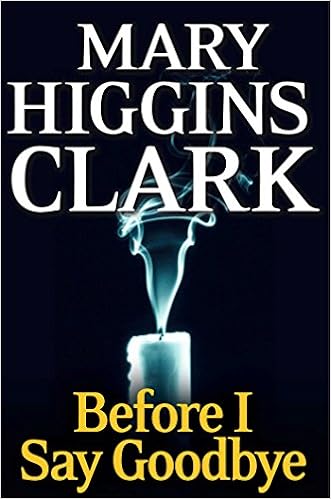
Before I Say Good-Bye by Mary Higgins Clark

Reviewed by Gerti

Mary Higgins Clark’s novel “Before I Say Good-Bye” is about a woman with more psychic powers than sense. Protagonist Cornelia (Nell) MacDermott has spent her life hearing from the dead. Her parents came to visit her after they had died in a tragic place crash. Also during her childhood, she sensed that her grandmother came to see her after she passed. But her grandfather, who raised her after those deaths, is skeptical about this whole psychic thing, and since Mac is a blustery but powerful New York politician, Nell generally plays along with him. That is, until her husband is killed in a boating tragedy, and she is left wondering why she can’t “sense” his presence. Mac wants her to leave it alone since he hopes Nell will run for his congressional seat. But Nell is wracked with guilt because of a fight she had with her husband before he left on that boat trip.

Fortunately for Nell, she has a great aunt named Gert who not only believes in psychics, she consorts with people with extra-sensory perception. She convinces her niece to see a medium who says she’s received a message from Adam Cauliff, Nell’s husband. He was an architect and, using money he borrowed from Nell’s trust fund, he had purchased a NYC property that is just about to pay big dividends. Adam was going to design the new building for that spot, and build it along with primo Manhattan real-estate developer Peter Lang.

But Bonnie the medium tells Nell that she sees Peter Lang dripping with blood, and Nell wonders if he wasn’t the man behind her husband’s boat accident. Lang was supposed to be on board the vessel that day, meeting with a number of other developers, but Lang got into an accident on the way there, and never made the meeting. Clark wants us to believe this is highly suspicious.

She also throws a number of other suspects our way – the son of the woman who sold the property, who not only has a long criminal history, but thinks Adam paid his mom less than she deserved for the piece of land. Then of course there’s the firm where Adam used to work, which is being investigated for bid rigging. Did Adam know more than they wanted revealed about their dirty dealings? And then there’s Adam’s secretary, whom he took with him when he left the previous architectural firm. She knew all about their business, too. She was also on the boat, so maybe she was the intended target of the explosion? There are other people on the suspect list, too, and Clark even goes into the lives of the cops who are investigating the explosion. And then there’s the kid who saw the boat blow up from a tourist craft nearby.


In the end, we find that the psychic was in co-hoots with the husband, who isn’t dead at all, but who was also stringing along his mousey secretary, who was in love with him, in order to make a mint of money. My critique - sometimes Clark loves writing so much that she writes too much. For me, “Before I Say Good-Bye” is one story where fewer characters might have made it more suspenseful.

Monday, April 18, 2016


The Last Coyote by Michael Connelly’s

Reviewed by Gerti

For Michael Connelly’s protagonist, former LAPD homicide detective Harry Bosch, the coyote is a metaphor for himself. He is one of the lone survivors in the terrible urban landscape of LA, trying to get by on his cunning and stealth. This is true when he tries to live surreptitiously in his cantilevered house, which has been condemned after the latest earthquake, but which he refuses to leave. He has been left behind by his previous girlfriend, who went to Europe, and now has been suspended from his job and forced to see a police shrink because he attacked his commanding officer. To watch this rebel and loner navigate this treacherous situation and come out on top at the end is what makes “The Last Coyote” (despite the wacky title) one of Connelly’s best novels to date.

Lucky for Hieronymous “Harry” Bosch, he knows how to work the system. He knows that you don’t have to be a cop to act like a cop, and until they take away his badge and gun (and even after they do, actually) he works to crack a case ignored for decades – the murder of his prostitute mother. For true Bosch fans, this book will be a delight, since there has been so little background information given out about their favorite LA cop. We have seen snippets in other books by Connelly, but not until “The Last Coyote” do we get to see the true story of Bosch’s mother, including finding out who killed her and changed (I wouldn’t quite say ruined) Harry’s life forever. Like the coyote, he faces trouble and survives.

Like all great mystery and crime stories, there is misdirection as Harry follows the clues that ultimately lead him to a criminal he did not suspect. There is for him also the bittersweet joy of discovering who his mother’s true friends (and enemies) were, and of course overcoming the natural obstacles put up by trying to solve a decades old cold case. But if anybody can do it, Bosch can. He even figures out why so little effort was put into solving the murder case initially, and he gets to meet the man his mother loved, and planned to marry.


If you’re a Bosch and Connelly fan like I am, you won’t be able to put this book down, and I couldn’t, even though the 512 page it takes to tell the story seem like a lot. Stylistically, it’s classic Connelly, with a clear-cut, no-nonsense style you just never want to stop reading. And in terms of the plot – it’s his usual non-stop, heart-pounding action as curmudgeon-y detective Bosch takes readers through his process, knocking corrupt cops and two-timing friends out of the way as he goes toward his goal. Connelly shows his maturity as a writer, and “The Last Coyote” delivers a treat to his legion of fans, with us seeing the softer side of hard-nosed Bosch, and learning what it is that made him the man we love. The book is just that – a way for fans to spend a long evening with Bosch over a bottle of wine and some smooth jazz, listening to him slowly tell the sad tale of his life, and crying with him over the heartbreak of lost chances and double-dealing friends. One of Connelly’s best, and well worth the read.  

Friday, April 15, 2016


The Two Mrs. Grenvilles by Dominick Dunne


This novel by Dominick Dunne is everything the backcover blurbs promise – compelling, steamy, engrossing, fast-paced, and diverting. Dunne has a reputation for being on the inside when it comes to information about the rich and famous, and this novel is no departure from that. His tale takes a sexually promiscuous showgirl and turns her into a society stunner after she marries the only son and heir to the New York Grenville fortune.

While not an original plot, Dunne’s treatment of Urse Mertens, a little nobody from Pittsburg, Kansas who turns into Ann Arden Grenville, arbiter of style and member of the jet-set and ultimately murderess, is fascinating. Dunne writes well, and only a few glitches (like saying that someone is a direct relation to Katherine Howard, Henry VIII’s 5th wife, who got her head cut off before she could produce any children for him) shows him to be fallible with the facts. His other details about the right place to buy one’s flowers, linens and clothes in New York, I’m hoping, are more en pointe.

Mostly, Dunne has a good sense for what makes people tick. His portraits not only of gold digger Ann, but of her stuffy mother-in-law Alice, and her hapless husband, Junior “Billy” Grenville, are rich and layered. He is not content to make them caricatures of themselves, but allows them to grow as people who make decisions and choices for very understandable human reasons, even if those decisions are not the right ones to make. Dunne shows Ann’s cleverness, which of course must face off against that of her wealthy boyfriend’s snobbish family. He shows their snobbishness, and that of their friends, but in the end it is only Ann’s crime that brings her back to being a person of little consequence.

It is not a short book, being over 300 pages, but it is an interesting one from beginning to end, as Ann is pursued by a writer who wants to know the truth behind the night her husband died, and to get a little revenge of his own for being marginalized by her years earlier. I sense hints of Truman Capote’s story here, a story Dunne would also know well, but he could be talking about his own experience of getting to the heart of high–profile, high-class crime.


I strongly recommend this book for adults, because some of the sexual escapades would probably be a bit much for young teens. I think you need to be a bit cynical to enjoy the story, which is a story of luck and ambition, both of which eventually run out for the younger Mrs. G. This would make a great book to take along to a spa or resort, because it will take you some hours of leisure living to get through, but you won’t want to put it down until you do.  

Friday, March 4, 2016


Nighttime Is My Time by Mary Higgins Clark

Review by Gerti

Mary Higgins Clark has written a large number of books very well. However, this novel, “Nighttime Is My Time,” is not one of them.

It tells the story of protagonist Jean Sheridan who is called back to her hometown of Cornwall-on-Hudson in New York for a class reunion. She is one of the famous alum’s from Stonecroft Academy, and is therefore one of those being specially honored by that school during the reunion. Unfortunately, many of the girls she used to sit with at her lunch table have since died, and that’s pretty unusual.

It takes a long time for players in this story to realize that a killer called “The Owl” is on the prowl. He is on a mission of revenge against the girls who used to laugh at him in school (predictable), and no amount of money or success after high school can lure him away from the madness of murder. The problem is, the evidence points to one of the honorees being the killer, but which one is it? Mark Fleischman, Gordon Amory, Robby Brent, Jack Emerson, or Carter “Howie” Stewart? The author leads you on a wild dance of red herrings as she makes each of them look guilty. And then you have to learn the names of the five murdered girls and their back stories, and where they ran into the killer again… and then you’re introduced to other non-Stonecroft victims, because the killer has knocked off other vulnerable women besides those from the school during his career because he just likes killing. It all gets to be TMI – too much information.


While I liked the premise and the story Clark weaves, the cast of characters here was just too huge for me. Her writing is always a pleasure to read, and I liked protagonist Jean, but there were just too many suspects to keep everybody straight. I am a huge fan of MHC, but I read her books for relaxation. I don’t want to treat them like college assignments, taking notes about the character’s different backgrounds or putting together a flowchart to figure out how everyone is related, and that is what I’d have to do here with NIMT to keep things straight. I simply want to be entertained when I read Clark’s novels, and this mystery, clever as it is, requires too much heavy lifting for me to follow along easily. I’d skip this one, Clark fans. 

Monday, November 9, 2015


Daddy's Little Girl by Mary Higgins Clark
reviewed by Gerti

Mary Higgins Clark can be an excellent writer, and the book “Daddy’s Little Girl” is a shining example of that. It is written in the first person, which is apparently a departure for the popular suspense writer, as it is mentioned several times in reviews of the novel. It is the story of an investigative journalist named Ellie Cavanaugh who was only a child when her older sister was murdered. Now, decades later, the man convicted of her murder is preparing to be set free, with help from his uber rich and powerful family. Ellie is determined to use her investigative skills to make sure that doesn’t happen, and in a modern twist, starts a website to prove his guilt, if not in her sister’s murder, than in other shocking crimes, like trying to kill his grandmother for her money.

Ellie is a compelling heroine, made more so by the fact that for many years she felt guilty about her sister Andrea’s murder, as she knew about the hideout where her rebellious older sis would meet boyfriends and girlfriends to commit teenaged indiscretions. It is Ellie’s belief that her parents felt the same way, and that Andrea’s murder was the thing that broke up their marriage. Ellie’s mother has died, after being an alcoholic for a long time, and after dragging Ellie all around the country to maintain her job. Ellie’s father, who she practically refuses to speak to because she feels he abandoned them, has remarried, and Ellie has a half-brother who is a rising star in the basketball world.

The secondary characters in this story are also brilliantly drawn. They are Rob Westerfield, the 19-year-old convicted of Andrea’s murder, who thanks to his money and connections now has a crime writer working on a biography to prove he did not commit this crime. Will Nebels is the shiftless local handyman, who suddenly emerges with a new piece of evidence pointing the finger at another local teenager, the mentally challenged Paulie Stroebel, who was working at a garage the night of the murder and had access to Westerfield’s car (and the murder weapon – a tire jack). Stroebel’s mother wants to keep him out of another trial just to save his fragile mental health, not because he killed the girl.


As the plot goes on, it is Ellie’s investigative skill that gets her evidence of other crimes and misdemeanors committed by Westerfield, but how far will his family go to keep it all quiet? The book kept me reading far into the night, with its engaging heroine, dramatic plotline (involving a fire and a suicide attempt), and heartless villain, who has a history of crimes against women. The suspense only builds as Ellie finally puts the puzzle together, but will Westerfield and his cronies stop her before she can tell anyone else? “Daddy’s Little Girl” is a rich and complex novel, and I strongly recommend it to anyone who loves crime fiction AND happy endings.

Friday, October 23, 2015


To Kill a Mockingbird by Harper Lee
Review by Gerti

I recently told a Hobart librarian that I didn't like this book, but the truth was that I hadn't read it since I was in high school.  So to be fair, and to get a feel for the characters again before reading "Go Set a Watchman"' I picked up the kid's paperback.  I had forgotten what a rich experience this classic book is, and I think it is a better read now than 30 years ago for me, since I now know so much more about the author and the other characters, as well as about life!

Who doesn't love the main characters of Scout, Jem, Atticus and Boo Radley?  Having done some reading about Truman Capote, I found out that the character of Dill was about him, since he and Harper Lee grew up as neighbors.  This means that if we assume Scout is Harper herself, than what she says about Dill gives me an insight into the boy Capote was before he became a famous writer, and that to me is fascinating.  You see through her text how the dysfunction and disorder in his family life made him a broken toy, and a brilliant author.

I also looked beyond the traditionally taught message of how poorly black people were treated in 1930's Alabama, to see how women were treated at the time, and was amazed to find the huge number of references Lee makes to what a Southern woman is and should not be, and what constitutes lady-like behavior to the older generation of women in her town.  Lee's book was modern not only by showing how unfairly black people were treated by the population at large and by the justice system in particular, but also showed how sexual stereotypes hurt Scout and Dill as they grew up unable to conform to the social standards of the past.

The plot is pretty well known: the children of a widowed Southern lawyer suffer hostility from local children and adults while their father defends a black man wrongly accused of raping a white woman.  While Atticus Finch proves beyond a doubt that Tom Robinson never committed the crime, the jury still convicts him, and he dies trying to escape.  But during the trial, Atticus shows that Bob Ewell, the father of the accuser, is a liar, an drunkard and a child abuser, and that rankles the man so much that he tries to hurt the Fnch kids while they are coming home from a school play one dark evening.  Only the intervention of a local recluse, Arthur "Boo" Radley, prevents the children's injuries from being worse.  

So yes, Mr. Librarian, I have now re-read the book and find that I love it.  I can't wait to read Lee's sequel, despite all the negative press it has gotten.  her writing here is lovely, as she uses Scout's childish, southern-accented voice to tell her larger tale of a certain time period in American history.  But that doesn't prevent the other characters in the book from coming to life, as they do.  This book makes me sad that Lee didn't publish more novels, but I'm hoping we'll find more manuscripts of hers eventually.  TKAM is a classic novel that everyone should read once (or maybe twice!) in their lives.