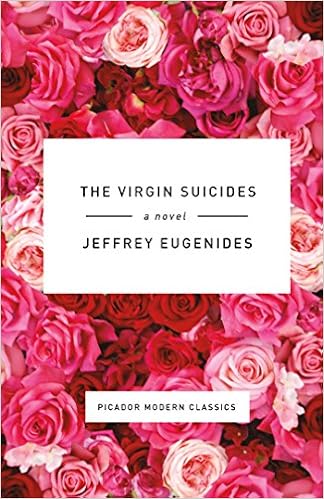
The Virgin Suicides by Jeffrey Eugenides
reviewed by Gerti
Once
upon a time, there were five teenaged sisters who lived in a large
house with very religious parents. As is common in a close community,
they are the objects of the focused attention of a group of
neighborhood boys. Then the youngest girl, 13-year-old Cecilia
Lisbon, tries to kill herself, using the ancient roman method of
cutting her wrists in the bath. She is found in time and rushed to
the hospital. Everyone collectively breathes a sigh of relief, and
soon the family tries to get back to normal, inviting a few of these
neighborhood boys over for a party. Although her wrists are bandaged
and covered with festive bracelets, Cecilia doesn’t seem to enjoy
the party, and excuses herself to go upstairs. But soon the party
hears the wet sound of her body being pierced by the metal-spiked
fence outside. She was simply too depressed to live. Or is it all an
allegory about a teenager becoming a woman?
While
Cecilia was seen as the strange one, the other girls, 14-year-old
Lux, 15-year-old Bonnie, 16-year-old Mary, and 17 year-old Therese,
take the death of their sibling very hard. Everyone tries to resume a
normal life in the wake of the suicide, and some boys even ask the
sisters to a high school dance. Their strict parents agree only if
the girls go in a group. Trouble is not far away: there is some
drinking and some making out. But Lux, the promiscuous one, ruins it
all by not returning home by curfew. She has obviously slept with her
date. Although Mr. Lisbon teaches at the local high school, the girls
are now kept home from the school they attended to keep them from the
gossip and stares they engender. Soon, the ladies are all cloistered
inside. Only the father leaves the house, to go to work, but it’s
not too long before Mr. Lisbon is fired from the school, too.
The
community and media initially rallied behind the family, using them
as the local example of a national trend, and yet… As the months go
by, the house gets more run down and people see the occupants less
and less. Food is delivered. People stop visiting the family. The
boys are still obsessed with the surviving Lisbon girls, and a rough
kind of communication is worked out where the girls get them to call
the house, and then stay on the line after the father has hung up.
During one poignant phone call, nuanced records are played by both
sides, who are using the lyrics to express their buried feelings for
each other. The girls convey the message that they plan to escape one
night, and the boys eagerly enter the house to help them flee.
Unfortunately, June 9th
is the day Cecilia made her first suicide attempt, and that date is a
deadly anniversary for the rest of the girls, who all feel the need
to die with her so they can be together again.
The
book is written once everything has happened, and the best part of
the narrative is the archive the boys have kept of the Lisbon girls.
Eugenides writing style is breezy and frequently amusing for such
weighty subject matter, making it an easy, but disturbing read. While
I’m sure it’s fraught with levels of meaning, if it’s all an
allegory about sexuality and becoming a woman, it’s a grim one.
