Brand New at the Library!

Showing posts with label Sisters Fiction. Show all posts

Friday, November 6, 2015


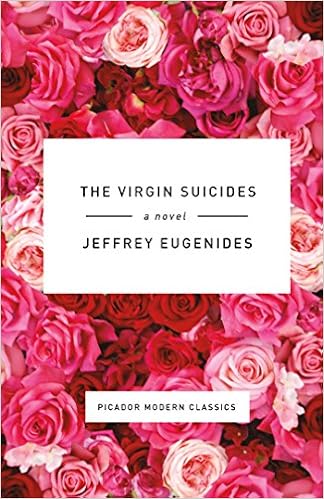
The Virgin Suicides by Jeffrey Eugenides
reviewed by Gerti

Once upon a time, there were five teenaged sisters who lived in a large house with very religious parents. As is common in a close community, they are the objects of the focused attention of a group of neighborhood boys. Then the youngest girl, 13-year-old Cecilia Lisbon, tries to kill herself, using the ancient roman method of cutting her wrists in the bath. She is found in time and rushed to the hospital. Everyone collectively breathes a sigh of relief, and soon the family tries to get back to normal, inviting a few of these neighborhood boys over for a party. Although her wrists are bandaged and covered with festive bracelets, Cecilia doesn’t seem to enjoy the party, and excuses herself to go upstairs. But soon the party hears the wet sound of her body being pierced by the metal-spiked fence outside. She was simply too depressed to live. Or is it all an allegory about a teenager becoming a woman?

While Cecilia was seen as the strange one, the other girls, 14-year-old Lux, 15-year-old Bonnie, 16-year-old Mary, and 17 year-old Therese, take the death of their sibling very hard. Everyone tries to resume a normal life in the wake of the suicide, and some boys even ask the sisters to a high school dance. Their strict parents agree only if the girls go in a group. Trouble is not far away: there is some drinking and some making out. But Lux, the promiscuous one, ruins it all by not returning home by curfew. She has obviously slept with her date. Although Mr. Lisbon teaches at the local high school, the girls are now kept home from the school they attended to keep them from the gossip and stares they engender. Soon, the ladies are all cloistered inside. Only the father leaves the house, to go to work, but it’s not too long before Mr. Lisbon is fired from the school, too.

The community and media initially rallied behind the family, using them as the local example of a national trend, and yet… As the months go by, the house gets more run down and people see the occupants less and less. Food is delivered. People stop visiting the family. The boys are still obsessed with the surviving Lisbon girls, and a rough kind of communication is worked out where the girls get them to call the house, and then stay on the line after the father has hung up. During one poignant phone call, nuanced records are played by both sides, who are using the lyrics to express their buried feelings for each other. The girls convey the message that they plan to escape one night, and the boys eagerly enter the house to help them flee. Unfortunately, June 9th is the day Cecilia made her first suicide attempt, and that date is a deadly anniversary for the rest of the girls, who all feel the need to die with her so they can be together again.


The book is written once everything has happened, and the best part of the narrative is the archive the boys have kept of the Lisbon girls. Eugenides writing style is breezy and frequently amusing for such weighty subject matter, making it an easy, but disturbing read. While I’m sure it’s fraught with levels of meaning, if it’s all an allegory about sexuality and becoming a woman, it’s a grim one.

Wednesday, September 30, 2015

 Sense and Sensibility by Joanna Trollope

Review by Gerti

Let me start by saying that it takes enormous cheek for a writer of any reputation and ability to name her book after one which is already considered a classic. I think Jane Austen’s “Sense and Sensibility” qualifies as such, and Austen is a popular enough author that many people know of the novel, even if they haven’t read it. So for Joanna Trollope (who?) to name her novel the same thing, and to use many of the same characters, is an outrage to me.

I’m sure Trollope, a popular author of many other books and an Austen fan, would say that she has just modernized Austen’s story, and therefore has the right to use the characters and just loosen things up a bit, morally speaking, and throw in some modern tech, like computers and Facebook. Since I’ve read many other Austen-homage books, I should be comfortable with that sort of thing, done successfully in “The Jane Austen Book Club” and “Austenland”, among other texts. But none of those authors were bold enough to just call their books “Pride and Prejudice” or any of Austen’s other well-known titles, and I don’t think Trollope should have taken that liberty, either. Her work pales by comparison.

As for the story Trollope writes, it follows the direction of Austen’s work, even if Trollope has added embellishments, like giving first names to characters like Mrs. Dashwood, the mother of Elinor, Marianne and Margaret, and to Colonel Brandon. While Brandon retains most of his dignified character from the original, “Belle” Dashwood comes off as an unlikeable, selfish hippy. Her imprudence (at not marrying Mr. Dashwood in the first place) sets up the fall from grace for the family of four women, as they are sent from their house at Norland when Henry Dashwood’s son (by his real wife) inherits the estate. Elinor is still the sensible daughter, and she recognizes the need to get work when they are sent packing, but neither Belle nor Marianne, the younger daughter, are grounded enough in reality to feel the need to contribute financially to the family’s survival. Marianne is young, which makes her sin of selfishness more forgivable, but it is intolerable to have middle-aged Belle simply live off the charity of a relative (Sir John Middleton) or her daughter’s paycheck. Belle also tries to mooch off of Mrs. Jennings when country living gets too boring for her, but fortunately the old lady is wise to her manipulative ways and does not ask her to join her in London.


But is the story worth reading? Yes, I suppose it is, for desperate Austen fans, but mainly for the ending, where Trollope goes beyond Austen’s story and has Edward’s mother forgive him for his youthful indiscretion with Lucy Steele, and give him a little money. The end also finds Fanny Dashwood getting a comeuppance by her mother, whom she is trying to manipulate so she’ll cut her brother Robert out of her will, as she did with her brother Edward. The mother doesn’t fall for it, which makes this reader for one cheer to see Fanny thwarted in at least one of her greedy escapades. As for “Trollope’s voice” which is vaunted by a cover blurb praising the author, I find it sadly unequal to Austen’s original.