Brand New at the Library!

Monday, December 28, 2015


The Shadow of Your Smile by Mary Higgins Clark
Reviewed by Gerti

In “The Shadow of Your Smile”, bestselling author Mary Higgins Clark has written yet another suspenseful tale with interesting, characters – some likable, and some you love to hate. In the former category is the protagonist, Dr. Monica Farrell, who of course takes care of sick kids, but comes from a less than privileged background. Her father was adopted, and he never learned who his parents were, although he was the spitting image of his former boss (!), millionaire Alexander Gannon. The Gannon fortune is currently being squandered by Gannon’s nephews and other board members of the Gannon Foundation, so much so that they can no longer meet their grant commitments to the hospital where Monica works.

You can already see the direction the story is taking – Farrell will be related to Alexander Gannon, and the rightful heir to the fortune. But other interesting characters populate the story, like Olivia Morrow, an 82-year-old woman who knows the secret of Monica’s ancestry, but fails to act before she is killed. In fact, the plot is littered with bodies, many of whom Monica knows, like her former friend and stalker who also wants to tell her that he’s found out about her relationship to the Gannon family.

There is a vague religious aspect to this novel as well, with Monica witnessing a spontaneous cure of a child’s brain tumor that his family attributes to their praying to a nun the Catholic Church is considering making a saint. The religious woman, named Sister Catherine, was related to Olivia Morrow, so she’s conflicted about confessing to the world what she knows about Sister Catherine giving birth to a child. Yes, she got pregnant by Alexander Gannon, and they gave the baby away. All the pieces of the plot fit neatly into place, so neatly in fact that the book is pretty predictable.

The writing is still clever, the action-like scenes from a soap opera, with thwarted romance and police detectives lurking around each corner. I always love Clark’s writing, and do like that the outcome of the story is predictable to some extent, since it means that the trail was laid properly. What I don’t like is minor – we are lead to believe that one of the board members (and one of the nephews) is more evil than the other, but the reverse turns out to be true. So it turns out there is not one murderer, but several, and that is what I find implausible. If only one character had gone rogue to preserve their piece of the Gannon fortune, I would understand. But by the time several normally upstanding citizens are poisoning people and putting pillows on their faces, it just seems like science fiction rather than suspense.


“The Shadow of Your Smile” is a pleasant enough read if you don’t mind escapist literature. But I found the tale of a nun who had a baby and a cadre of high-society killers stretch the bounds of credibility. Still, I enjoyed reading it. 

Monday, December 21, 2015

Homicide in hardcover : a bibliophile mystery.


Homicide in Hardcover: a Bibliofile Mystery by Kate Carlisle
Reviewed by Gerti

I love books and so does the main character in Kate Carlisle's "Homicide in Hardcover," we just love them in different ways.  I love to read (and review!) them, and protagonist Brooklyn Wainwright loves to restore them.  This book is certainly good reading if you are interested in finding out all about the tools and equipment used to do just that.

It is less entertaining, or at least was for me, if you are interested in real characters in real settings.  Or real good writing!  There are very few books that I stop reading (perhaps one or tow during my lifetime), but I was very close to doing that after trying to plow through this novel's first chapter.  Starting with the fact that I found the main characters name pretty obnoxious (not that anyone named Gerti should even try to make THAT argument!) I also hated her life details even from the start.  It felt like I was reading a rehash of recent alternative mystery series with occupational hooks like "This Pen for Hire" (by Laura Levine)or the Hannah Swensen mysteries by Joanne Fluke, which involve a lady who runs a bakery, but just happens to find dead bodies everywhere.

"Homicide in Hardcover" is formulaic like that.  Take a heroine with a vocation, in this case repairing rare and expensive books for people, and throw a dead body in front of her.  In this case, that of her former mentor in the business, Abraham Karastovsky.  Of course, you need to have the heroine cross the path of a difficult but gorgeous man, with whom she begins a relationship.  And then toss in a few stereotypical baddies, like a woman who wears tight leather and speaks with a foreign accent.  Add some odd parents, in this case hippies who run a winery, and some equally eccentric neighbors.  In Levine's case, a gay man with super sensitive hearing.  In this case, a pair of lesbians with a cat and house pants which need tending.  Can you see how this is all beginning to sound familiar?

Of the three writers, Levine, is the best, but I enjoy Fluke's recipes as well.  That leaves Carlisle as the odd woman out, although apparently she does have quite a following because a number of books in the Bibliophile series have been published.  I just don't think I'll be reading another one, as I found so much of this so implausible.  Solves the murder, inherits millions, and ends up with a hunky Brit with a Bentley?  Come on!  If I'm going to be reading fantasy, I'd prefer to visit outer space.  And if I want comedy, I'll read Levine or Evanovich, who are much funnier writers.  In the end, I just didn't like any of the characters enough to want to spend time with them again.


Friday, December 18, 2015

The boys in the boat : nine Americans and their epic quest for gold at the 1936 Berlin Olympics

The Boys in the Boat: Nine Americans and Their Epic Quest for Gold at the 1936 Berlin Olympics
 by Daniel James Brown
Reviewed by Gerti

The subtitle to Daniel James Brown's book "The Boys in the Boat" is "Nine Americans and Their Epic Quest for Gold at the 1936 Berlin Olympics."  Unlike my son, who ruined the ending for me by telling me who won the race (when I was more than 500 pages in!) I will not tell you, although even if you know, the book is still worth reading.  Brown's book is a heart-filled work of fiction that will leave you breathless until the end.  It is much more than a simple sports story!

The heart of the book is the life story of Joe Rantz, who went to the University of Washington and was a member of its storied rowing crew.  Rantz is a character with whom most readers will fall in love.  I certainly did.  He is a young man who had the worst life imaginable.  His mother died when he was young.  Hank, his father, abandoned him, and Joe went to live with a relative.  When his father finally came back to his senses (and his son), he found a second wife, a lady named Thula, who despised Joe.  When she and Hank began to have children of their own, Thula convinces him to move to Seattle, and leave Joe behind.  Alone.  During the depression.  In a half-finished house with little food.  Yes, it is heart-breaking to see how cold-hearted a woman she was!

But Joe never quits.  There was a story called "Unbroken" about another Olympic athlete who had to face inhuman conditions, and Joe is made of the same stuff.  Although abandoned, Joe finds a way to stay alive, feed himself, and works hard enough to send himself to college.  At Washington, it is his ability to survive punishment that makes him great at a sport like rowing.  He also has to endure ridicule of fellow students because he always wears the same sweater.  It is the only one he has.  Can you imagine that?  But Joe does not give up or fee sorry for himself; he just works harder.  And of course, Joe finds himself seated in a boa with other poor but scrappy fellows like himself.  And then he goes to the Olympics with them, against all odds, while the rich-boy rowers stay home.

Rowing itself is another character in the book, and the way Brown describes what it demands of its athletes is epic.  We meet Joe's coach, his crew mates, and spend a lot of time with George Yeoman Pocock, who designs and builds the boat the boys race in.  He was another poor boy with impossibly high standards for himself who made good in the US.  He inspires Joe when he is faltering, and it is quickly evident that he does more for the team than make their boats.

The only part of the book I find distracting is Brown's decision to politicize the Olympics.  Everyone knows Hitler was bad.  Nazis were bad.  We get it.  Brown is at his best when he's talking about the sport and describing the lives of these gifted rowers, not weighing us down with redundant history.  He doesn't use overkill talking about the depression or the dust bowl, but he does with Hitler.  To me, the "Boys in the Boat" are the fascinating part, and Brown would have done better to abandon his political agenda and tell the tales alluded to by his title.

Monday, December 14, 2015


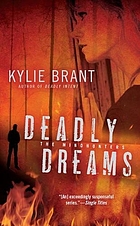
Deadly dreams : the Mindhunters

Deadly Dreams: The Mindhunters by Kylie Brant
Reviewed by Gerti

"Deadly Dreams" is the 2nd of the Mindhunter books that I have read by Kylie Brant, and I have to say, I like it better than the last one, "Waking the Dead".  Brant seems more focused on the genre here, although there is still some heat between the two main characters who are trying to track down a cop killer.  Brant used to write intimate romance books, but in "Deadly Dreams," her clear and accessible style works beautifully telling a grim story of immolation and revenge.

The protagonist is a former Philadelphia cop named Maris Chandler, who move to the Mindhunters, but then left the business of crime-fighting completely after a tragic case where a little boy died.  She is teamed up with Nate McGuire, the detective in charge of a special Philadelphia Police Department task force trying to catch a killer targeting cops, past and present.  Risa has special skills though--she has psychic dreams that enable her to get a jump on those clues sought by other detectives.

Nat McGuire is the tall, dark, and handsome type, but he has not ime for romance because he has spent years taking care of the autistic son of his alcoholic sister, Kristen.  Still, he finds himself drawn to Risa, who likewise has not time for love, since she's still dealing with the trauma of failing t save a ittle boy who had been kidnapped.  She's also dealing with her boss, Mindhunter CEO, Adam Raiker, who keeps dropping in on her unexpectedly as he is also being stalked by a killer who has tried to bring him down several times.  The FBI has supposedly tracked the assassin down, but they've erred, and Raiker is shot again.  Chandler is traumatized, and after a long night at the hospital, heads home to sleep, only to awaken to her home on fire, as the cop killer now perceives her special skills as a threat to his discovery.

Chandler survives, but the close call makes McGuire reveal is feelings about her, and leads to her spending the night at his place.  Yes, there is a sex scene, but it's all secondary to the couple working on the crime spree, and eventually, they get it figured out.  Now Chandler just has to get to the last kidnapped cop in time, before the killer has the chance to set him on fire.

This book has a great plot, and moves along at a fast pace.  It is markedly better than the previous book of her that I read, her writing is good enough to get me to track down some of her other crime novels, and find out more about this diverse group of criminologists called "the Mindhunters".  I have already checked out one of the blurbs on the cover which says Brant is destined to become a star.  She IS if she can keep writing them like this!  "Deadly Dreams" will keep you up late into the night, reading!


Monday, December 7, 2015


The Suspicion at Sanditon (Or, The Disappearance of Lady Denham) 
A Mr. & Mrs. Darcy Mystery by Carrie Bebris
Reviewed by Gerti

Carrie Bebris has made her career turning the adventures of Jane Austen's beloved characters from " Pride and Prejudice", Fitzwilliam Darcy and his bride Elizabeth Bennett, into sleuths.  This series has worked out well for her, but like many of her fans, I wondered what would happen when she finished the 6th book in the series, since Jane Austen only ever finished 6 novels.  "The Suspicion at Sanditon" (Or, The Disappearance of Lady Denham) solves that mystery for her fans.

Luckily for Bebris, Austen left several fragmentary novels, and "Sanditon" was one of them.  So here, her husband and wife mystery team makes their way to the seaside town on the rise, Sanditon.  They meet the characters that Austen originally penned, Miss Charlotte Heywood, the Parker family with it's several peculiar siblings, and the wealthy widow, Lady Denham.  But here the mystery commences when the childess widow goes missing during a dinner party to which all the characters have been invited.  So many suspects, and much misdirection as several other dinner guests also go missing!  Finally, under the Darcy's careful attention, the mystery is solved, while romances are made (and dissolved!) and fortunes are gained (and lost!)

The mystery began many decades before when the daughter of Sanditon House's resident hermit went missing.  The girl's name was Ivy Woodcock, and while she is now the principle mystery in the village of Sanditon, she also has a deep connection to Sanditon House and its resident family, the Hollises.  The son of the house was in love with her before she went missing, and his father disapproved, of course.  So was there foul play, or something even more interesting?  The neighboring house, inhabited by the equally wealthy Denham family, is hoping to get a share of the inheritance, since Lady Denham married their father, now also deceased.  An a Hollis is also hanging around, hoping that the old lady will think kindly about the original residents of the house in which she now dwells, and return the place to that family.

Yes, there are many suspects, and the truth, as Bebris finds it, is even more peculiar.  Bebris' writing is wonderful as always, and really carries with it the tone of Austen's orginal.  Unlike so many authors, she can adopt the style of the wildly popular British author without getting bogged down in her sometimes convoluted syntax and antiquated terminology.  Bebris does a fine job of modernizing this work so it doesn't sound like another Regency romance writers has pounded it out, but what she can't help is that so few Austen fans really know the characters from Sanditon.  I've read all of Austen, but was much happier in the mysteries derived from "Pride and Prejudice" or "Sense and Sensibility" than in this less familiar world.  And there are so many characters in Susten's work that Bebris has to include them all, which made it all kind of confusing to this reader.  Too many Parker's, and too many Denham's, and how many generations do we have to go back to get to Ivy?  In short, I enjoyed the book just to hang out with Darcy and Elizabeth for a time, but would probably have to read it again to get every nuance straight, so it's probably my least favorite Darcy mystery set Bebris has written.


Tuesday, December 1, 2015


The Mysterious Death of Miss Jane Austen by Lindsay Jayne Ashford
Reviewed by Gerti

So many books have been published that deal with characters in the novels of Jane Austen, a great British author who died in 1817, but very few of the Austen related novels deal with her life in a fictional way.  "The Mysterious Death of Miss Jane Austen" is one that does, and it is a very good book, one that might appeal to Austen's myriad fans.

Lindsay Ashford's premise is that not only was Jane Austen poisoned, which is what accounts for her untimely death at 42, but there was a serial poisoner in her family.  That person, whom the narrator, Anne Sharp uncovers by her own observational skills and Jane's clues, is Mary Austen.  She is able to marry into the Austen family through Jane's older brother, James, after his first wife dies.  And unlike her sister Martha Lloyd, who uses her knowledge of herbs to cure people, Mary uses her gift to ill them to further her own greed and lust.

Governess Anne Sharp meets Jane Austen in 1805 when she is watching the children of another of Jane's brothers, Edward, who was adopted by a wealthier but childless side of the family.  Hence, he has an estate called Godmersham, while his sisters and his mother are left nearly penniless after the death of the Reverend Austen.  Anne wonders that Edward lets his relatives be so poor when he has so much, but the key lies in Edward's wife, Elizabeth, who is too busy being snobby to be generous to Austen's family, whom she considers beneath her.  Elizabeth has other flaws as well, as Anne discovers that Elizabeth is sleeping with Jane's charming brother Henry, and in fact seems to have had several children by him, all while remaining married to Edward.

Henry is in fact so charming, that while he married a wealthy older cousin to the Austen's, he is also cuckolding brother, James, by sleeping with Mary.  it's all very complicated unless you know the family relationships (and yes, this book could use a family tree in it somewhere).  Mary supposedly poisons James' first wife to get him to marry her, although she is unattractive and a bit of a shrew, and poisons Elizabeth, in order to have Henry for herself.  Eliza (Henry's wife) also dies, and strangely, so does James, Mary's husband.  Now the road would be clear for Henry to marry Mary, but he does not, and that makes her very angry.  Anne realizes that Mary poisoned Jane whom she was nursing during that last month of her life.  Mary and Jane had never gotten along before, so it seems odd to Anne that Mary would be so attentive during Jane's illness.  Then she realizes the connection between all the other strange family deaths.

While this novel seems well written, it also seems a little implausible to me that the poisoner is Mary.  Ashford does float other suspects, like Henry himself, since he always seems to be hanging around women, and I even thought gentle Cassandra, Jane's sister, might be behind things for a bit.  But it's an interesting book that Ashford has written, even if I don't buy her conclusion.   


Friday, November 27, 2015


The Incredible Adventures of Daniel Boone's Kid Brother, Squire by W. Fred Conway
reviewed by Gerti

By size and weight, this seems like a throw-away pamphlet, but W. Fred Conway’s work on Squire Boone has more substance than it would appear at first glance. He takes the story of the Boone family, especially famous brother Daniel and less-famous sibling Squire, from their early days in the Yadkin Valley of North Carolina, through Squire’s burial in Boone Caverns, which he discovered while hiding from Indians in southern Indiana.

The story is almost apochryphal, with Daniel Boone constantly getting into scrapes, captured by Indians, etc. and his baby brother coming to his rescue. The first story told by Conway shows how several other companions of the Boone boys were killed or lost in the Kentucky woods, but the Boone boys always managed to survive their trials and return to their wives back in Yadkin. So competent were they as woodsmen, that they were able to explore the country separately for a year and then keep an appointment to meet at noon on a specific July day in a hidden encampment.

The Boone’s traversed much of Kentucky, and would eventually help found several forts against Indian attacks, including Fort Painted Stone near Shelbyville, Fort Boonesborough near Winchester, and Fort Harrod, near Harrodsburg. Squire was an important figure in the history of Indiana as well, since he founded the first Baptist Church in the state, near Laconia. He was a self-ordained Baptist minister, who also performed the first marriage west of the Appalachians, with the bride one of three teenaged girls he saved after Indians abducted her. He is also considered one of this country’s first environmentalists, as he was very concerned, despite bringing many settlers here, about maintaining the wonderful wilderness in our region, too. He even spoke to that point while a delegate in Kentucky’s first legislative assembly.

Squire’s enduring legacy, however, seems to be Squire Boone Village near Corydon, Indiana. He built a gristmill there with his son after going broke when some land speculation deals fell through. They used the water flowing out of the caves to power the mill, and apparently, it still grinds grain the way it did two centuries ago. Nowadays the tourist attraction “village” also has a bakery, and soap and candle-making displays. You can see his burial casket, or at least the monument erected by the Daughters of the American Revolution in his honor, as both Daniel and Squire were made honorary Army Captains by a special act of Congress.

While not as laudable as it once seemed, Squire Boone clearly fought many battles with the Native Americans in order to settle the wilderness that became the states of Indiana and Kentucky. He saved many settlers lives, and even came up with primitive fire extinguishers made from rifles to deal with flaming arrows shot into forts. Squire was an educated man who believed in God, knew the woods, and had many skills valuable in the new territories, acting as a carpenter, a miller and a gunsmith during his lifetime.


While Conway’s language is sometimes awkward, he tells a good tale about a fascinating historical figure of great regional importance. This book would be appreciated by any child, teen or adult with an interest in the early battles that created our state and, ultimately, our nation. It’s a shame Squire Boone is not as well known as his brother.

Monday, November 23, 2015


Descent by Jay Bonansinga
reviewed by Gerti

I love the television series “The Walking Dead” on AMC, but I don’t like reading graphic novels, so Jay Bonansinga’s book “Descent” is a wonderful way to check in on my favorite characters and settings, as well as see some great “what happens next” action about a place the television show left behind.

In “The Walking Dead” series, the town of Woodbury has been destroyed after a character named “The Governor” messed with and captured several members of Rick Grimes group. Rick is the protagonist of the TV series, and has gathered around him a group of like-minded individuals since the zombie apocalypse. But he is very protective of “his people,” and has to rescue them when they are captured, no matter the consequences. Lucky for Rick, his group is very skilled at extraction and weapon use, so the citizens of this small Georgia town are no match for him. The town’s defenses are breached, which is bad news as it allows zombies, an ever-present enemy in the story, to enter the town at will.

This book begins after the Governor has left Woodbury, and the town and its citizens left to their fates. A woman named Lilly Caul has become the de facto new leader. She is trying to run things differently than the Governor, but fate is against her. Zombies are no longer wandering around one by one, which makes them easy to destroy, but in something called a superherd, and one of those is headed straight for her town. Fortunately, a new family has arrived in the haven that is Woodbury, and one of its members will do any to save her children, even if it means sacrificing herself to do it. First crisis averted!

An even greater threat, however, comes from a young boy whom the Woodbury survivors saved from starvation outside its walls. He convinces the group that his church group is surrounded in a nearby town, and that they must save them. Thanks to the discovery of an underground network of tunnels, remnants from the Underground Railroad days in the South, the group is able to free the other humans, led by a charismatic preacher named Jeremiah. Over time, Lilly willingly hands the reins of power over to him so she can concentrate on her romantic needs, totally unaware that the religious group in fact has made a suicide pact and they are just waiting for the right time to take the townsfolk with them.


The book is a terrific read. I loved meeting the new characters, and Lilly is a great, if flawed, protagonist. I often wondered with the TV series why Rick’s band didn’t come back to Woodbury once their prison shelter was destroyed, but I am glad that some author realized the town was still viable as a haven from “the biters.” Bonansinga writes in a clear, yet exciting way, and I felt swept along with the action. His characters are also clearly drawn and different enough that I felt they were real people. Bravo to Bonansinga for creating a believable group of human survivors and putting them in dramatic new situations! Can’t wait to read more by this author. 

Monday, November 16, 2015


Empire by Orson Scott Card
reviewed by Gerti

For those who have read Orson Scott Card’s classic science fiction novel “Ender’s Game”, the book “Empire” will sound familiar. The hero here is not a small boy, but a seasoned war veteran, who understands that conflicts are not only fought with weapons, but also with words and deeds. When we first see Reuben Malich, the soldier is stationed in an Arab country. He sees and survives an ambush with rare and almost prescient intelligence. This special knowledge gets him recruited for other anti-terrorist missions. Which is why it is no surprise that when Reuben comes back home, his Princeton history professor selects him as a verbal sparring partner.

The debate between Reuben and his teacher, Averell Torrent, about whether the United States is like Rome before the days of empire becomes the central theme and core question of the book. Card’s point, which is brilliantly made, is that the US is like Rome before it became an empire, and our various political divisions now are just prelude to one strong leader seizing power and uniting the country. In this book, that leader is Torrent. What Reuben doesn’t know at the beginning stage, is that the professor’s siren call has been heard by many people, some of them with the money and connections to bring such a change about.

I don’t want to ruin the plot for you, but Reuben gets involved in this conspiracy to end democracy in the US based on some paper he wrote about the best way to kill the President. His new assistant, Captain Bart Coleman, is with him the day they see scuba diver’s heading toward DC intending to fire rocket launchers at the White House. Reuben and Cole (his nickname), are able to prevent one assassin from firing his weapon, but another’s weapon has already gone off, killing the President, the Secretary of Defense, and several other important people who had gathered in one place. Reuben is a suspect, especially after a trip to NYC with Cole occurs during the first battle in a war to take over that city.

Reuben’s jeesh, which is Arabic for posse, try to help him figure out who is setting him up, and who is behind all the high tech weaponry they see in New York. These soldiers Reuben formerly fought with have a cadre of special skills, and together with Cole, they help uncover a conspiracy to make his former college history professor America’s new dictator. After he is killed, Reuben’s wife Cecily and Cole continue to gnaw away at the extent of the conspiracy, but stop when they realize how dangerous it is to oppose this country’s new leader.


A tremendous book which will probably be especially appealing to those who love conspiracy theories. I’m not a big fan of war or politics, but this book was so well written by Card, and the characters were so well defined, that it was a joy to read up until the end. I hated that protagonist Reuben died three-quarters of the way through, though, and constantly expected him to show back up.

Monday, November 9, 2015


Daddy's Little Girl by Mary Higgins Clark
reviewed by Gerti

Mary Higgins Clark can be an excellent writer, and the book “Daddy’s Little Girl” is a shining example of that. It is written in the first person, which is apparently a departure for the popular suspense writer, as it is mentioned several times in reviews of the novel. It is the story of an investigative journalist named Ellie Cavanaugh who was only a child when her older sister was murdered. Now, decades later, the man convicted of her murder is preparing to be set free, with help from his uber rich and powerful family. Ellie is determined to use her investigative skills to make sure that doesn’t happen, and in a modern twist, starts a website to prove his guilt, if not in her sister’s murder, than in other shocking crimes, like trying to kill his grandmother for her money.

Ellie is a compelling heroine, made more so by the fact that for many years she felt guilty about her sister Andrea’s murder, as she knew about the hideout where her rebellious older sis would meet boyfriends and girlfriends to commit teenaged indiscretions. It is Ellie’s belief that her parents felt the same way, and that Andrea’s murder was the thing that broke up their marriage. Ellie’s mother has died, after being an alcoholic for a long time, and after dragging Ellie all around the country to maintain her job. Ellie’s father, who she practically refuses to speak to because she feels he abandoned them, has remarried, and Ellie has a half-brother who is a rising star in the basketball world.

The secondary characters in this story are also brilliantly drawn. They are Rob Westerfield, the 19-year-old convicted of Andrea’s murder, who thanks to his money and connections now has a crime writer working on a biography to prove he did not commit this crime. Will Nebels is the shiftless local handyman, who suddenly emerges with a new piece of evidence pointing the finger at another local teenager, the mentally challenged Paulie Stroebel, who was working at a garage the night of the murder and had access to Westerfield’s car (and the murder weapon – a tire jack). Stroebel’s mother wants to keep him out of another trial just to save his fragile mental health, not because he killed the girl.


As the plot goes on, it is Ellie’s investigative skill that gets her evidence of other crimes and misdemeanors committed by Westerfield, but how far will his family go to keep it all quiet? The book kept me reading far into the night, with its engaging heroine, dramatic plotline (involving a fire and a suicide attempt), and heartless villain, who has a history of crimes against women. The suspense only builds as Ellie finally puts the puzzle together, but will Westerfield and his cronies stop her before she can tell anyone else? “Daddy’s Little Girl” is a rich and complex novel, and I strongly recommend it to anyone who loves crime fiction AND happy endings.

Friday, November 6, 2015


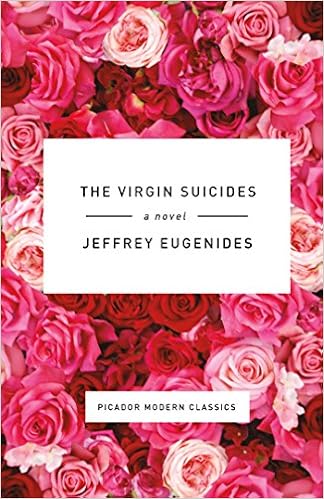
The Virgin Suicides by Jeffrey Eugenides
reviewed by Gerti

Once upon a time, there were five teenaged sisters who lived in a large house with very religious parents. As is common in a close community, they are the objects of the focused attention of a group of neighborhood boys. Then the youngest girl, 13-year-old Cecilia Lisbon, tries to kill herself, using the ancient roman method of cutting her wrists in the bath. She is found in time and rushed to the hospital. Everyone collectively breathes a sigh of relief, and soon the family tries to get back to normal, inviting a few of these neighborhood boys over for a party. Although her wrists are bandaged and covered with festive bracelets, Cecilia doesn’t seem to enjoy the party, and excuses herself to go upstairs. But soon the party hears the wet sound of her body being pierced by the metal-spiked fence outside. She was simply too depressed to live. Or is it all an allegory about a teenager becoming a woman?

While Cecilia was seen as the strange one, the other girls, 14-year-old Lux, 15-year-old Bonnie, 16-year-old Mary, and 17 year-old Therese, take the death of their sibling very hard. Everyone tries to resume a normal life in the wake of the suicide, and some boys even ask the sisters to a high school dance. Their strict parents agree only if the girls go in a group. Trouble is not far away: there is some drinking and some making out. But Lux, the promiscuous one, ruins it all by not returning home by curfew. She has obviously slept with her date. Although Mr. Lisbon teaches at the local high school, the girls are now kept home from the school they attended to keep them from the gossip and stares they engender. Soon, the ladies are all cloistered inside. Only the father leaves the house, to go to work, but it’s not too long before Mr. Lisbon is fired from the school, too.

The community and media initially rallied behind the family, using them as the local example of a national trend, and yet… As the months go by, the house gets more run down and people see the occupants less and less. Food is delivered. People stop visiting the family. The boys are still obsessed with the surviving Lisbon girls, and a rough kind of communication is worked out where the girls get them to call the house, and then stay on the line after the father has hung up. During one poignant phone call, nuanced records are played by both sides, who are using the lyrics to express their buried feelings for each other. The girls convey the message that they plan to escape one night, and the boys eagerly enter the house to help them flee. Unfortunately, June 9th is the day Cecilia made her first suicide attempt, and that date is a deadly anniversary for the rest of the girls, who all feel the need to die with her so they can be together again.


The book is written once everything has happened, and the best part of the narrative is the archive the boys have kept of the Lisbon girls. Eugenides writing style is breezy and frequently amusing for such weighty subject matter, making it an easy, but disturbing read. While I’m sure it’s fraught with levels of meaning, if it’s all an allegory about sexuality and becoming a woman, it’s a grim one.

Monday, November 2, 2015


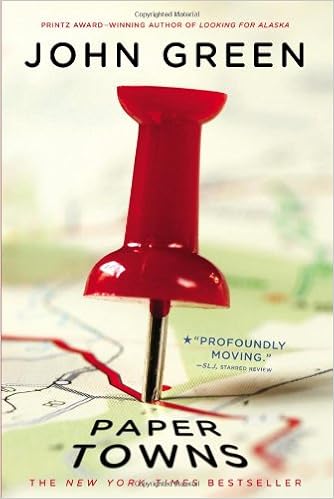
Paper Towns by John Green
reviewed by Gerti

I’ve read several John Green books now, and while “Paper Towns” is not my favorite, it is not his worst either. PT has a typical Green formula - a charming pre-college narrator (Quentin Jacobsen in this case) who travels the country, amidst tortured tales of teen angst and romance. High school senior Q (short for Quentin) is in love with his neighbor, Margo Roth Spiegelman, who is far more attractive, more interesting, and more everything than Quentin. She is a popular girl with a reputation for fearlessness, and as such, hell breaks loose when she finds out her boyfriend has been cheating on her. Q helps with her multifaceted revenge plan, but when Margo’s breakup precedes her leaving town, “Paper Towns” turns into “Looking for Alaska,” another (better) Green novel in which the female love interest disappears, forcing the protagonist into a road trip of self discovery. In this case, it is also literally a trip from Florida to a “paper town” in New York.

Quentin faces the same issues faced by Alaska’s hero – has the girl he was crushing on killed herself? To find resolution, Q and his friends (fellow seniors Radar and Ben, as well as Ben’s girlfriend Lacey) follow clue after clue in order to track down a mercifully still-living Margo. But there are few happy endings in life, and there is none here in “Paper Towns”, for while the band of friends find Margo in Agloe, New York (a town which doesn’t really exist at all), Margo didn’t want to be found. The “paper town” destination is a metaphor for Q’s relationship with Margo herself. He is in love with his idea of her, and not with the person she really is. In the same way, a paper town exists only on paper, a place invented by map publishers to keep others from stealing their information.

This book, like all of Green’s novels, is populated by fascinating, quirky, sometimes brilliant characters. The situations presented are also relatively unique, but I like this book less than some of Green’s previous efforts, perhaps because Margo is so very unlikeable. Her revenge plan for her cheating boyfriend is over the top, her idea of fun (sneaking into Sea World when it’s closed) is over the top, and her final departure from her previous life, family and friends, is so abrupt and final that she seems seriously damaged, rather than charmingly adventurous. She has deep-seated psychological problems and needs professional help, not just a group of supportive friends. Her pattern of living alone in deserted buildings (one a mini-mall filled with asbestos) is dangerous and for a young, attractive woman, a recipe for disaster.


Green’s books are usually charming, fun and easy-to-read, but this novel leaves me with a sour taste. When Q leaves Margo behind, I root for him to get over her, because I don’t see her story ending in anything besides suicide. I understand Green’s message – that we can never really know other people - but that ground was covered more effectively over a hundred years ago by Nathaniel Hawthorne in “The Minister’s Black Veil.” Avoid making a trip to this “Paper Town.”

Wednesday, October 28, 2015


Bridget Jones: Mad About the Boy by Helen Fielding
Review by Gerti

I love Bridget Jones and I'm not afraid to say it.  I'll shout it if you need me to.  I love Bridget Jones, and I love the many books (3 now) that Helen Fielding has penned about her wacky adventures.  I love that Bridget keeps track of the same crazy things I do--calories, weight, etc., but I also love that she keeps track of things I never do--like alcohol consumed or boyfriends shagged.  Having her be similar to me in some ways and different in others means I can laugh with her, and AT her, at different times, but always with the utmost affection.

In her previous diaries, Bridget had two wonderful men after her, including mark Darcy (played by Colin Firth in the movie version) which totally makes me love him, too.  Her former boss Daniel was played by Hugh Grant, and there are not two British men in the world that I adore more than Firth and Grant.  So even as I read about their adventures, in my mind I can see their gloriously handsome faces, and imagine their endearing mannerisms.  Yes, I do have it bad, than you very much.

Bridget Jones to me now is also the actress, Renee Zellweger, so as she gets her white coat stained by her daughter's hot chocolate before a major school even, I see her face, and that makes it all so much more intimate.  It's like watching the adventures of a friend, a clumsy, humorous, accident-prone, self-doubting, weak-willed friend whom I love.So in this book, "Mad about the Boy", I am not totally put off it becausd mark Darcy has died tragically.  Like helping a widow through hter days of grief, I stuck by Bridget as she tied to take care of their two kids, and make a new life for herself among the ashes.  I loved how she tried to engage with the modern world, tweeting, getting on FB (or not), and dealing with all the uber-moms at the children's school.  I liked how she found a young man to date, but saw the plot twist coming when an older man (equally buff, though. Bridget doesn't date ugly men!) from her son's school became her friend.

In short I love Helen Fielding's writing style, and this story, and while there are a lot of things happening to the English language in England that don't really click with Americans like me (who don't spend time overseas), you catch on eventually, even to unusual terms like Spag Bog (Spaghetti Bolognese).  Yes, it's apparently one of England's most popular meals, and Bridget's kids love to eat it.  those touches give the book its unique flair, and while I missed Darcy, I was rooting for Bridget to succeed at putting her life back together, and she has.  By the end, she's got a better relationship with her Mom, her Neighbors, even the most put-together mom at school as she finds out everyone is just bumbling along, despite appearances to the contrary.

I'm told they are working on the movie version of this book, but Hugh Grant refused to be in it, which is a sham.  If the movie is even half as fun as reading the booi, consider my ticket already bought.

Friday, October 23, 2015


To Kill a Mockingbird by Harper Lee
Review by Gerti

I recently told a Hobart librarian that I didn't like this book, but the truth was that I hadn't read it since I was in high school.  So to be fair, and to get a feel for the characters again before reading "Go Set a Watchman"' I picked up the kid's paperback.  I had forgotten what a rich experience this classic book is, and I think it is a better read now than 30 years ago for me, since I now know so much more about the author and the other characters, as well as about life!

Who doesn't love the main characters of Scout, Jem, Atticus and Boo Radley?  Having done some reading about Truman Capote, I found out that the character of Dill was about him, since he and Harper Lee grew up as neighbors.  This means that if we assume Scout is Harper herself, than what she says about Dill gives me an insight into the boy Capote was before he became a famous writer, and that to me is fascinating.  You see through her text how the dysfunction and disorder in his family life made him a broken toy, and a brilliant author.

I also looked beyond the traditionally taught message of how poorly black people were treated in 1930's Alabama, to see how women were treated at the time, and was amazed to find the huge number of references Lee makes to what a Southern woman is and should not be, and what constitutes lady-like behavior to the older generation of women in her town.  Lee's book was modern not only by showing how unfairly black people were treated by the population at large and by the justice system in particular, but also showed how sexual stereotypes hurt Scout and Dill as they grew up unable to conform to the social standards of the past.

The plot is pretty well known: the children of a widowed Southern lawyer suffer hostility from local children and adults while their father defends a black man wrongly accused of raping a white woman.  While Atticus Finch proves beyond a doubt that Tom Robinson never committed the crime, the jury still convicts him, and he dies trying to escape.  But during the trial, Atticus shows that Bob Ewell, the father of the accuser, is a liar, an drunkard and a child abuser, and that rankles the man so much that he tries to hurt the Fnch kids while they are coming home from a school play one dark evening.  Only the intervention of a local recluse, Arthur "Boo" Radley, prevents the children's injuries from being worse.  

So yes, Mr. Librarian, I have now re-read the book and find that I love it.  I can't wait to read Lee's sequel, despite all the negative press it has gotten.  her writing here is lovely, as she uses Scout's childish, southern-accented voice to tell her larger tale of a certain time period in American history.  But that doesn't prevent the other characters in the book from coming to life, as they do.  This book makes me sad that Lee didn't publish more novels, but I'm hoping we'll find more manuscripts of hers eventually.  TKAM is a classic novel that everyone should read once (or maybe twice!) in their lives.

Monday, October 19, 2015


Woman in Gold

Movie Review of Woman in Gold
Review by Gerti

Gustav Klimt is an artist from turn-of-the-century Vienna whose work you either love or hate.  I happen to love it, and saw many canvases in person in a gallery in Vienna when I visited many years ago.  One of Klimt's most famous works is often called "Woman in Gold", just like the name of this movie, but it is actually the portrait of Adele Bloc-Bauer, and this movie is the story of Adele's niece, Maria Altmann, and her fight with Austria to get that popular picture back.

Actress Helen Mirren plays Altmann, an emigre from Austria in the 1930's now residing in America.  She and several lucky members of her family fled when the Nazi's took over Austria and made things difficult for Jewish people.  They left with just the clothes on their backs, and the Nazi's took away their businesses and possessions, which for Maria's family included 5 gorgeous Klimt pictures.

Several decades after WWII, the new Austrian government wanted to make things right for the families who had been robbed by the prewar policies.  Maria spotted an article about it in the New York Times which made her wonder is she could get their families pictures back as well.  Her friend's son is a young and inexperienced lawyer named Randy Schoenberg, played handsomely by Ryan Reynolds.  His family also emigrated from Austria, and they are related to famous composer Arthur Schoenberg, which shows that they are also cultured people.  Randy is captivated by Maria's hard-luck story and plucky personality, and decides to make the trip to Europe to see if he can help reclaim her treasures.

As a young Austrian reporter says, though, the "Woman in Gold" is Austria's Mona Lisa, and that country is very reluctant to return it, despite their desire for good publicity, and justice.  They claim Adele's will says it goes to the Belvedere Gallery, but Randy and Maria prove that since Adele's husband bought the pictures, and he outlived her, it's his will that dictates what happens to them, and he gave the to Maria.  Austria continues to fight, this time using money as a weapon, andRandy has to take the legal case to the US Supreme Court (and win) before Austria finally agree to mediate.  Throughout the movie, Maria wants to come to an agreement with the Austrian museum, but they make it very hard on her, as do her many memories of ther final frantic days in that nation in 1938.

This move will move you to tears, and make you laugh.  It is a fascinating story of how Austria finally makes things right for he elderly American lady.  The acting is top notch, the story is well written and the music beautiful, including some phrases I recognized from a movie adaptation of Jane Austen's "Persuasion."  The film is also visually appealing, with Austria's beautiful urban scenery contrasting sharply with the incomprehensible horrors of its past.  There is a happy ending, with Austria doing the right thing, and it is nice to see Maria vindicated, and Randy getting his career started with such a rousing success.  With no graphic images to frighten younger viewers, I heartily recommend this stunning "Woman in Gold".


Monday, October 12, 2015

Image result for take a bow by elizabeth eulberg


Take a Bow by Elizabeth Eulberg
Reviewed by Gerti

This is the second young adult novel I've read by Elizabeth Eulberg.  Her "Prom and Prejudice" was a clever send-up of Jane Austen's classic novel of British literature, "Pride and Prejudice".  I loved that book, but found "Take a Bow" to be a bit lackluster, perhaps because I wasn't as interested int he subject matter.

The main character of this book is Emme Connelly, a red-headed, green-eyed beauty who does not like to be the center of attention.  This contrasts with her best friend at the beginning, Sophie Jenkins, a star in the making, and the reason both girls attend a performing arts-oriented high school called CPA in New York City.  Sophie seeks the spotlight as a singer, and the although Emme also loves music, she writes it instead, which make them a perfect partnership.  Only Sophie isn't happy that Emme's star is rising at CPA, as Emme has become involved with three other guys and formed a band, Teenage Kicks, which despite the sad name is receiving mild success even outside school now that they are seniors.

in an attempt to get her name in the public eye, Sophie starts to date a former child star who in on the acting track at the school, a boy named Carter Harrison.  She appears with him at all kinds of events, but is mad that the pictures are usually cropped to cut her out.  She also has a musical rival at the school, so even when there are musical productions there, Sophe doesn't get the lead.  her trump card is the original music that Emme writes for her, bus she abused the friendship.  Sophie gets a new best friend, give her the credit for a great song Emme wrote her, and those girls trade catty e-mails about Emme that she accidentally sees.  Nice girl Emme finally decides it's time to ditch this user loser.

Sophie tries to explain things away as she has done many times before to get back in Emme's good graces, but it's no good.  Emme's star rises as she is a featured performer at CPA and gets accepted at Julliard.  Sophie's nasty tricks finally do her in, as Emme refuses to help her anymore.  Sprinkle this friend drama with a few cute boys, and you've pretty much got what this book is about.

While I do like Emme as a character, as well as the other three guys in the band (including Ethan, who love love loves Emme), Sophie is just too nasty to enjoy reading about.  Eulberg breaks the book up into alternating chapters told from delusional Sophie is about Emme, blaming the latter for all her troubles (even though Emme has been nothing but supportive until the end), it is also distracting for the book to be splintered like that.  i also disliked how Eulberg narrated many conversations in the book, a page-filling technique I think she took from David Levithan, who I've seen use it before.  I don't like his books at all, and feel that the's been a negative influence on Eulberg as a writer,  I have yet to read " The Lonely Hearts Club", written by her, but have my fingers crossed that it will again be as good as "Prom and Prejudice".