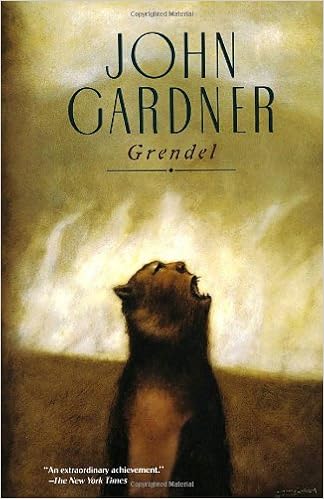
Grendel by John Gardner
Review by Gerti
“Beowulf”
is an Old English epic poem that many of us had to read in high
school or college. Esteemed writer John Gardner takes the classic
work, and turns it on its head here in “Grendel”, much in the way
“Wicked” retells the story of “The Wizard of Oz.” Like that
novel, Gardner takes the monster of the story, Grendel, and allows
him to tell the tale, and like “Wicked”, once the bad guy starts
talking, the heroes and villains are not as black and white as they
appeared.
We
see the humans around King Hrothgar after we've already met
Grendel, and after Grendel has already established that he is more
than your ordinary monster. Gardner sets him apart from the animals
early, but instead uses animal terminology when referring to the
humans in the story. Like vermin, Grendel is always seeing them with
rat faces, or acting like snakes. And just as humans find it easy to
kill rats, it is believable and nearly forgivable that Grendel would
have little trouble killing them when the time came.
Grendel
is conflicted about his role in the universe, and Gardner sometimes
shows him to be a superman character since he is much stronger than
humans and can even see in the dark. Grendel himself, however, has
heard the humans talk about how he is an outcast, the descendant of
the Bible story’s murderous brother, Cain. Humans, he hears, are
from another lineage altogether. It is during a scene where Grendel
tries to approach the humans in friendship that they begin their
attack on him, as they don’t understand his form of language, even
though he keeps crying out “friend”. He is so strong, even his
fingernails are capable of killing the humans, and the survivors of
the Danes drive him away from their gathering place, the mead hall.
Grendel
is a tormented soul, for although he has other creatures with whom he
can speak, namely his mother and a dragon (who calls him son and
treats him with more civility than the humans do), he wants to be
accepted among the humans, and that’s just never going to happen.
He is obsessed by the humans, and spends most of his life watching
them from mountain tops and in the shadows of their village. He sees
how badly they treat animals, how they kill for sport, how they set
careless fires in the forest. He begins to think that nothing
matters, and this novel becomes a nihilist anthem. Finally, hero
Beowulf arrives to fight Grendel, but the creature has already lost
his will to live.
Among
other adjectives of praise heaped on the book, the cover blurbs call
“Grendel” original, poignant, witty, intelligent and delightful.
It is all those things, and will most definitely appeal to a teen
audience, as well as to anyone who share the mindset of one of
society’s outsiders. Grendel is a modern “Frankenstein” and I
highly recommend this memoir of his, created by the very talented
writer, John Gardner.

No comments:
Post a Comment