Brand New at the Library!

Monday, August 29, 2016

As time goes by : a novel

As Time Goes By by Mary Higgins Clark

Reviewed by Gerti

It’s a sad thing for this fan to admit, but Mary Higgins Clark is old. She has been writing thrillers for a very long time! And although “As Time Goes By” is a thrilling story written in her usual vein, it has some inaccuracies and idiosyncracies that I can only attribute to Clark not being “with it” in the modern sense. She probably isn’t on Facebook or Instagram, and it’s that sort of thing that sinks a book for the modern reader who is more acquainted with those technological advances than is Clark. For example, I had a hard time listening to her discussing TV journalist Delaney Wright’s job because I had worked in the broadcasting and many aspects of TV reporting and anchoring were portrayed clumsily here, as though Clark had little experience of it.

Another false note for me was the character named Singh Patel. Those are two last names from the Indian subcontinent, and it seemed odd that a character would have two last names, the English equivalent of naming your child “Smith Jones”. Perhaps it happens, but it is odd enough to make me think that Clark doesn’t know any people of Indian or Pakistani descent, and therefore just picked these names because they sounded foreign to her. Since she didn’t catch the awkward name herself, an editor should have caught and changed it.

But now that I’ve revealed my pet peeves, on to the highly implausible plot – A beautiful widow named Betsy Grant is accused of having murdered her wealthy older husband, a famed local surgeon laid low by early-onset Alzheimer’s. Delaney Wright is supposed to cover the trial, but is suddenly promoted to evening anchor. However, since she’s so great at reporting, they don’t want to take her off the court beat. And yet the news stories that Wright delivers about the trial are anything but fair! Wright would get fired for biased reporting if she really filed the news stories as Clark writes them here!

As a side plot, Delaney is obsessed with finding her birth mother. She was adopted illegally, so it’s hard to research, but those loveable lottery winners, Alvirah and Willy Meehan, are around to do the work for her. And as luck would have it, the accused murderess is her birth mother! Delaney was conceived at senior prom (could it be any other way?) and the boy didn’t even know Betsy was pregnant! Delaney stops reporting on the trial again, as now she would really be biased! And in another clumsy plot twist, Betsy just reconnected with her old prom date – and Delaney’s birth father – before her husband died, and they are again in love. But that info sounds awful when revealed during the murder trial!


There are other possible suspects in the doctor’s death – the other doctor’s in his practice, his shiftless son who is deeply in debt, that sort of thing. But the real problem with ATGB is that there are so many different “important issues” fighting for center stage here, the drama gets lost. Too many implausible coincidences and not enough fact checking turns NYC into Fantasy Island in this Clark novel.

Monday, August 15, 2016

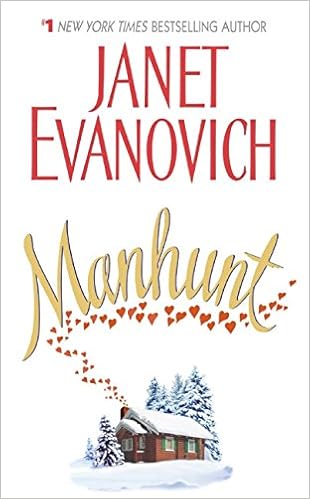
Manhunt by Janet Evanovich

Reviewed by Gerti

Janet Evanovich has the ultimate recipe for writing success in her numbered series of novels about bounty hunter Stephanie Plum (“One for the Money”, “Two for the Dough”, etc.) She tries to use a similar formula here in “Manhunt” - take a sexy but hapless career woman and put her in the craziest situations imaginable. In this book, successful NYC stockbroker Alexandra Scott decides to pitch it all, all her money and all her success, and head to Alaska on a whim to find a husband. Perhaps it is my status as a housewife, but I don’t believe that story for a minute. It is utterly implausible that a modern woman would trade her gorgeous clothes, fancy condo, etc. for an uber-rustic cabin and a broken-down store in the wilderness in order to catch herself a man.

While that may have worked as the plot of a 1950s Doris Day/Rock Hudson film, it is in fact the setup for the novel “Manhunt”, originally published as a Loveswept paperback in 1989. The 2005 re-issue (which is the edition that I read) is in slightly larger print, which is pretty easy on my over-50 eyes, which is why I chose it as a beach book. I wasn’t really looking for a romance book, but knowing its origins does explain the few steamier love scenes in the book which differ from the other half-dozen Evanovich books I’ve read already. Thankfully, the humor with which she writes is unchanged, and it is in fact the writer’s humor and charm that gilds this highly implausible turd of a tale.


I know I’m not alone when I admit that I read Evanovich books because they are great fun, and “Manhunt” is no exception. Her characters are vastly entertaining and appallingly unique. Her books are as easy to digest as a Twinkie and just as substantive, but I don’t care when I’m reading one because sometimes I don’t want to work that hard with a book. This one goes down easy, and I enjoyed reading about the Alaskan version of Mr. Darcy, hero Michael Casey, who saves Alex’s dog, gives her shelter after she burns down her own outhouse, and eventually proposes, because who doesn’t love a broke, beautiful airhead with spunk? Or maybe there really are no women in Alaska! Lucky for Alex, he’s rich and hunky, so all’s well that end’s well. You won’t be placing this book on your classics shelf next to Dickens or Tolstoy, but it will certainly warm up your beach blanket for a few hours! Read it and laugh, thankful that all the misfortunes that Alex has to face are not yours! 

Monday, August 8, 2016

Extreme prey

 Extreme Prey by John Sandford

Reviewed by Gerti

Meet the latest author with whom I am obsessed! John Sandford is a gifted storyteller and his protagonist Lucas Davenport is every bit as thrilling as the renegade cop Harry Bosch created by Michael Connelly. And Sandford is proving to be an even more prolific writer, as he’s already cranked out 26 “Prey” novels, which is how you recognize this series when you see them on the library shelf.

“Extreme Prey” is the perfect story for this election year, as there is a strong female candidate running for president, and just like with Hillary Clinton, there are those fanatics out there who dislike her strongly. Members of one family dislike her enough to want to kill her, and when the radical group they are part of refuses to back any so-called “direct action”, Marlys Purdy and her son Cole prepare to do it on their own. And they’ve got the skills – Cole is a former military man who not only can shoot any number of weapons accurately, but he is also able to construct an IED. Candidate Michaela (Mike) Bowden is alerted to the threat, but she’s counting on Davenport to neutralize it before she walks unguarded around the Iowa State Fair.

Although Davenport is originally from Minnesota, he makes himself at home in the politically active state of Iowa, and gets help from all sorts of police agencies as he tracks down the attempted assassins. He’s got a number of other crimes to solve, too, as the leader of one radical organization, the Progressive People’s Party of Iowa (and his girlfriend) die when the Purdy’s see them as threats. Another PPPI org member knows too much about a dairy bombing decades earlier, and he also gets iced. His death is the work of another group member (who has her own reasons for the murder). Davenport interviews a ton of people, and it’s only Sandford’s clever writing and the fact that Davenport is such a brilliant but likeable scoundrel that keeps it all flowing.

Finally the day of the fair arrives, and although Davenport knows his chief suspects by sight, they allude him and set up camp before he gets there. Then it’s a race against time before the bloodbath begins. I won’t ruin the ending for you, but I will say it is worth reading, as every Sandford book I’ve touched seems to be so far. The ending is even a little ironic, as good and bad people die, yet no one second guesses the candidate on her decision to attend the Fair even though it cost innocent bystanders their lives. The reader is left with a moral question about where the fault for their death lies. Of course the assassins did their damage, but if Bowden hadn’t been stubborn and insisted on going to the event for PR reasons, blameless people would not have been injured or died.


Sandford is clever and his plots are intricate. His characters seem real, whether he’s writing about the police detectives, the politicians, or the people who lives on hard-scrabble farms. Don’t miss “Extreme Prey”! It’s a page-turner! 

Monday, August 1, 2016


Coraline

Coraline by Neil Gaiman

Reviewed by Gerti

Like Neil Gaiman’s “Fortunately, The Milk”, “Coraline” is a book the famed author has written for young readers, 8 and above. However, unlike the former book, “Coraline” is a real treat for adults to read, and the creepy illustrations by artist Dave McKean, while few, set the tone for the scary little book perfectly. It is short on words – 162 pages in my copy – but long on imagination, including a mouse band (in training), a theatre filled with dogs, and a talking (sometimes) cat.

It’s the story of what happens when a young girl named Coraline (not Caroline!) moves into a new apartment with her very distracted parents. There are fascinating ladies downstairs (Misses Spink and Forcible) who apparently were successful actresses way back when, and the attic is occupied by a weird old fellow (who we eventually learn is named Mr. Bobo) who is working very hard at teaching mice to play music. Coraline is left to her own devices, which is how her attention is caught by a door in the drawing room behind which is a brick wall. Only sometimes, that wall isn’t there, and the adventure begins…

Coraline unlocks the door after her mother refuses to buy her the day-glo gloves she wants. When the mother goes to the market because there is no edible food in the frig, Coraline enters a passageway to a doppleganger world, where she finds an “other mother” with plentiful food and lots of imagination. The only strange thing, this mother’s eyes are buttons. As Coraline continues to visit, the woman’s appearance becomes even less appealing. In this other flat, which the mother created to look like the real world, Coraline finds friendship with the talking cat who tells her secrets about the place. The cat plays a critical role in her survival there.


After eating and sleeping in the shadow world, Coraline returns to find that her parents have disappeared. The actress ladies downstairs say Coraline is in danger, so they give her a magic rock with a hole in it as protection. It’s up to Coraline to bring her parents back to the reality, as well as to save the souls of all the other children who have gotten trapped in the spider’s web construct of the other world. A number of gruesome adventures follow, but Coraline is triumphant in her attempt to save them all. But did something evil follow her back through the door to the real world before she could lock it again?

Monday, June 27, 2016


Product Details


Unfed by Kirsty McKay

Review by Gerti

This is the second book in the series of zombie novels that Kirsty McKay has penned. This one is called “Unfed”, and the original book is “Undead”, or in my case, unread, but I have definitely put it on my reading list due to the quality of this book.

While the review blurb on the frontcover reads that “Unfed” is “fast, furious, freaky, (and) funny…” I would have to go with funny, although not LOL hilarious. The protagonist of the book is a teen-aged girl named Roberta, aka Bobby, and her mother is one of the scientists who set the zombie virus upon the UK. Right now, Scotland has been quarantined, and Bobby has been saved from a school bus crash caused by the undead. What she doesn’t realize at first is that although she is at a hospital, it is underground, and run by Xanthro, the company that “built” the virus. Oh yeah, and now they’ve improved on it, so that the zomb’s one runs across are now able to learn, which is pretty terrifying!

Bobby meets some other survivors of the crash at the hospital, including golden girl Alice, and white-mohawked intellectual Pete. Another kid who claims to have survived the bus crash is Russ, but Bobby has her questions about him, since she doesn’t remember him from before the accident. Still, he’s pulling his weight during the group’s attempt to get out of Dodge, and out of danger. The Xanthro pharmaceutical goons attempt to recapture them, and they try to outrun them, despite the ever-present danger of zombie adults, kids and even barnyard animals!

Bobby is trying to find her mom and her best friend, Smitty. Apparently he has the antidote inside of him, and she thinks she is a carrier of the disease, and wants to be cured. Her cell phone holds the answer to the location of both people, and some clever thinking enables the group to go to the Elvenmouth Lighthouse to signal for rescue. The Xanthro baddies make it there, too, and eventually they discover the boat where Bobby’s mom has been hiding. I won’t tell you who is saved (and who is the mole for Xanthro within the group), but suffice it to say that once you start reading, you will want to finish this book. It is fun, and all the British sayings just add to its charm.


Unfed” made me want to read McKay’s first book in the series, and to eagerly await her third book, since the ending of “Unfed” is a cliffhanger which sets the reader up for more adventures with Bobby and her zombie-killing cohorts. Bravo to McKay for infusing a youthful spirit into a genre that is often deathly serious. 

Monday, June 20, 2016


A Civil Action by Jonathon Harr

Reviewed by Gerti

It’s been quite a week for the legal profession in my house. First I finished Jonathon Harr’s “A Civil Action” and then watched Charles Dickens “Bleak House.” Together, those stories would convince any sane person to stay out of court, no matter what the personal cost!

The eponymous civil action in the Harr chronicle (which won the National Book Critics Circle Award for Nonfiction) involves the deaths of several children in Woburn, MA, ostensibly caused by chemical pollution of the water wells while they were growing up. One mother begins to question why her child has leukemia, and links it to the news that two wells have been taken off line. While medical doctors still claim no one knows what causes leukemia, this mom finds it astonishing that half a dozen children in her neighborhood have the disease. She gets a Boston law firm involved, and that’s when the fireworks start.

The story is mostly about attorney Jan Schlichtmann, a personal injury lawyer living the high life until this case begins to obsess him. He sees Beatrice Foods and another multinational corporation called W.R. Grace behind the water pollution, and thinks his firm will bring in millions for the plaintiffs. Instead, he gets embroiled in a case where the judge (Judge Skinner) is Harvard friends with one of the attorneys for the defense, and when that attorney tells Schlichtmann during the deposition phase that the families will never get to tell their stories on the stand, he’s right. Judge Skinner rules that before the families can testify, Schlichtmann and his firm have to prove that the wells were contaminated by the defendants. It turns what should have been a heart-breaking case of human health and happiness versus evil companies who are trying to make a profit, into a courtroom ecology lesson. Needless to say, the jurors let Beatrice, the company of the judge’s friend, off without a fine, and the case goes on only against W.R. Grace.

When Grace is finally found to have caused the well pollution, the settlement is so tiny the families are left with about $300K each and without the apology and acknowledgement of guilt they were initially seeking. But bringing the case to trial at all costs Schlichtmann and his law firm everything – they are nearly bankrupted by the medical and geological tests they needed to prove to the judge they had a case at all. When it’s discovered that the defendants didn’t provide all the documents they should have to the plaintiffs, the case goes to appeal – but even then there is no justice. The appeals judges send the case back to the already corrupt and fallible Judge Skinner, and he does nothing good.


“A Civil Action” is a brilliantly researched and written story about very bad people and a justice system that has anything but justice in mind. It terrifies me to think of all the pollution that exists in our water and in our soil, and only reaffirms that those people most responsible for ruining our environment never have to pay. 

Friday, June 17, 2016


Picnic by William Inge

Reviewed by Gerti

No one seems to remember William Inge, although back when our parents were seeing plays, he was producing classics that we would know, like “Come back, Little Sheba” and “Bus Stop”. “Picnic” is another stereotypical play from the ‘50s, where repressed womenfolk are just waiting to get a glance at a man with his shirt off. How times have changed!

The setting is a Labor Day Weekend, and we’re privy to the back yards of two middle-aged widows, one who has to take care of her cranky, elderly mother, and the other of with 2 daughters to get married off. The latter is named Flo Owens, and she knows her elderly daughter’s value; Marge is a beautiful girl, and Flo is hoping to marry her to a local rich boy. The other woman is Helen Potts, who gets the prefix Mrs., although she was only married for a few hours before her mother had the union annulled. Since this also happens in “The Last Picture Show”, I was familiar with the scenario. As a result, though, Mrs. Potts is, shall we say, interested in having young men help her around the yard. Hal Carter is one of those sexy young men, and as he prances around shirtless, all the ladies in the area get a thrill.

Among those who turn on him when he rejects her advances is a spinster school teacher who has given her all to a local salesman, and is just waiting for him to marry her. Her histrionics are painful to the modern reader. Mrs. Potts satisfies her lusts just feeding Hal and watching him work, but young Millie, Mrs. Owens’ tomboy daughter, is getting ready to become a woman and has her first crush on Hal. She starts drinking (for the first time) to loosen some inhibitions, but ends up getting ill. It’s her lovely older sister Marge who snags the preening Hal, who we learn went to school with her intended fiancé. The two were even in the same fraternity, but Hal turned out bad, since he didn’t have any family money.

The play ends as you might imagine from the work of a male author in the ‘50s; Marge falls so deeply in love with Hal, thinking him a kindred spirit, she throws over her sure-thing boyfriend, much to the chagrin of her scheming mother. But Inge wants us to cheer that action, like anyone in 2016 believes that a woman will fall so much in love within a few hours’ acquaintance that she’ll ruin her entire life for a shirtless man based on a kiss and some muscle-flexing. It’s pretty nauseating that women were once considered so simple and sex-starved. It’s about as based in reality as an episode of “Catfish”.


So I would advise modern readers to pass up this time capsule of a play. I could see how it could be updated, but why? I guess Inge’s attitudes are the reason I can never watch Marilyn Monroe in “Bus Stop” either. The “Picnic” seems in it’s own way to be more old-fashioned than Shakespeare’s “Romeo and Juliet”, in which the poetic language also makes the out-of-date attitudes palatable.